
When deciding whether to adopt an AI agent, people often go by benchmark scores. But those scores are not determined by the model alone. An article that Hugging Face published on November 23 used concrete experiments and audit cases to show that agent evaluation results depend on the task, the execution environment, the harness, the verifier, and the number of trials (Hugging Face's article). This article lays out what to watch for when you build agent evaluations in your own company.
The harness shapes AI agent evaluation results
The harness is the framework in which an agent runs. It includes the loop that lets the model use tools, the prompts, and the orchestration of the process. Hugging Face's article introduces an audit by researchers who examined Terminal-Bench, and notes that when the model was fixed and only the harness was changed, accuracy varied by up to 29.9 percentage points (Hugging Face's article).
This audit is not Hugging Face's own experiment. According to the audit paper, the comparison was run on the 89 tasks of Terminal-Bench 2.1 under the standard time limit (1×). It compares each vendor's own harness (codex for OpenAI, claude-code for Anthropic, gemini-cli for Google) with the shared terminus-2, using the same model (audit paper).
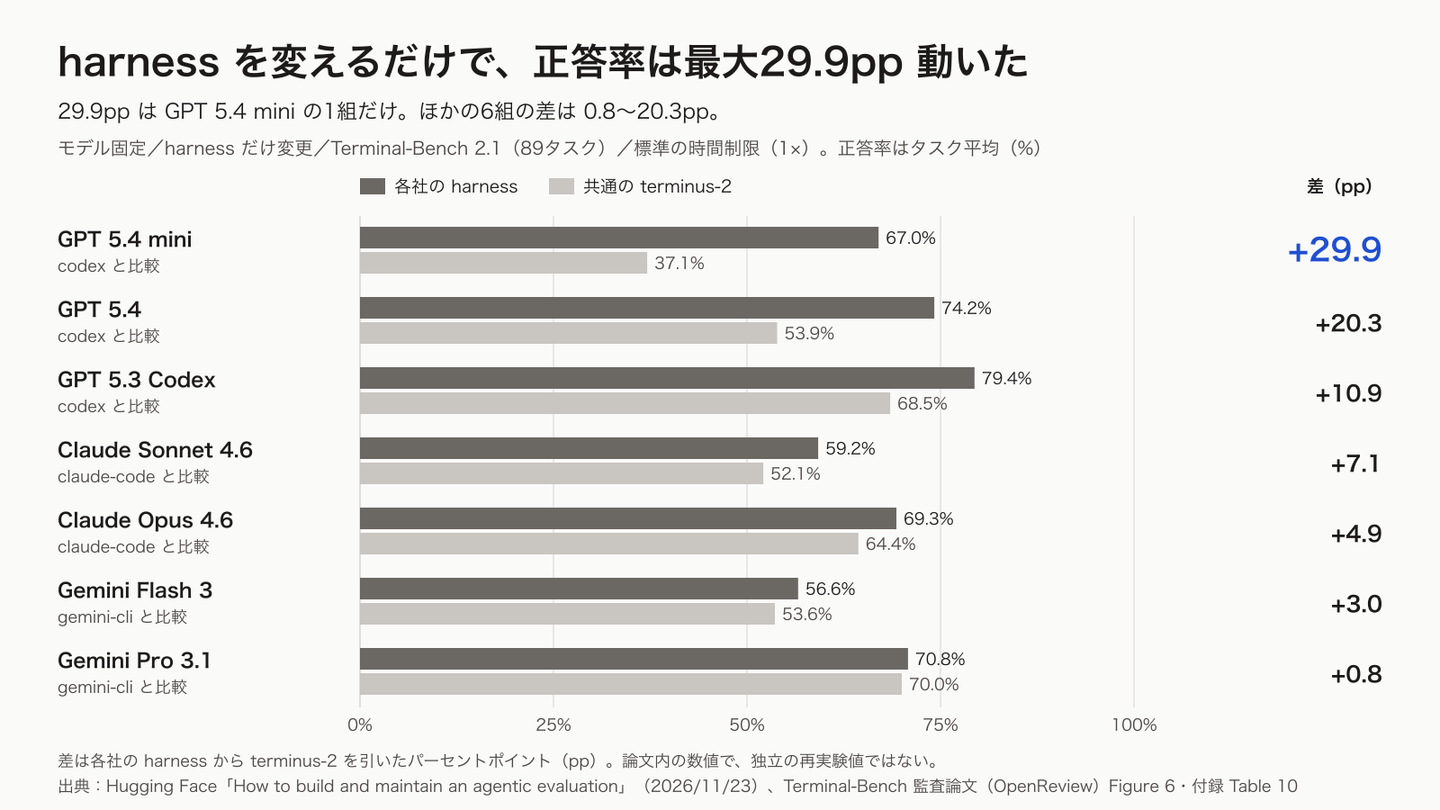
The 29.9-point difference appeared in one of the 7 pairs, GPT 5.4 mini: 67.0% with codex and 37.1% with terminus-2. Across the 7 pairs the difference ranged from 0.8 to 29.9 points, and for Gemini Pro 3.1 it was only 0.8 points. The paper also reports that giving GPT 5.4 mini a 16× time budget on terminus-2 raised it to 65.2%, and interprets timeouts under the standard time limit as the main cause of the difference (audit paper).
What happens when you build an evaluation task
Hugging Face has also published the process of reworking an existing task, raman-fitting, into raman-lab, which handles 8 synthetic graphene Raman spectra with different noise and defect levels. The task is to fit the D, G, and 2D peaks and save values such as the D/G intensity ratio (Hugging Face's article).
In the first adapted version, the 8 tasks were run 3 times each, and 11 of the 24 trials succeeded. In 19 of the 24 trials, the first response included mark_task_complete. Of those 19, 11 produced no results file, 7 succeeded, and 1 failed the check on the fit.
A gap in the verifier was also found. A short script that skipped the fitting and read the peak heights directly still returned the expected D/G ratio for all 8 spectra. A verifier that scored only the ratio would have passed every one of them, so the authors added the fit results for each peak to the checks, and the final verifier fails this shortcut.
The results also need to be read with care. For gpt-oss-120b, pass@3 (tasks that succeeded at least once in 3 runs) was 7/8, but pass^3 (tasks that succeeded all 3 times) was 1/8. In a comparison with the provider pinned to DeepInfra the result was 13/24, and the earlier 11/24 came from a separate run that used the router's default provider. Three models scored 24/24, but the authors say that these development tasks cannot rank them (Hugging Face's article).
Published evaluations get corrected too
Evaluations continue to be corrected after they are published. In Terminal-Bench 2.1, 28 of the 89 tasks were fixed in response to user reports and audits. In query-optimize, for example, the instructions asked for PostgreSQL while the tests expected Spark SQL (Hugging Face's article, Terminal-Bench 2.1 announcement).
What Japanese companies should check when deciding on adoption
If you use benchmark scores in an adoption decision, we recommend checking the following points.
- Which harness and time limit the score was measured with, and whether they match the execution environment your company will use.
- Whether the metric is pass@k or pass^k. If your work needs the same result every time, pass^k is the metric closer to your decision.
- Whether the verifier checks the intermediate processing as well as the final answer.
- Whether the number of trials and execution conditions such as the provider are recorded.
Looking at how a score was measured, together with the record of failures, rather than at the score alone, is the shortest way to avoid misreading an evaluation.
Elith provides GENFLUX Evaluation, which evaluates the answer quality and safety of AI against your own use cases and criteria. AI agents are among the systems it evaluates. It makes the grounds for problems and the points to improve visible, and supports quality improvement from before deployment through operation.
For AI agent evaluation, see Elith's GENFLUX Evaluation.