

When you run AI agents in production, restricting their behavior with policies does not by itself tell you how the agents actually behaved. An article that LangChain's Christine Manegan published on November 19 divides agent governance into "preventative" and "detective" governance, and positions observability through traces as the precondition for both (LangChain's article). The article assumes LangChain's own product, LangSmith, but it gives security and operations teams material for thinking about what to record first. This article lays out the original article's arguments.
Dividing AI agent governance into prevention and detection
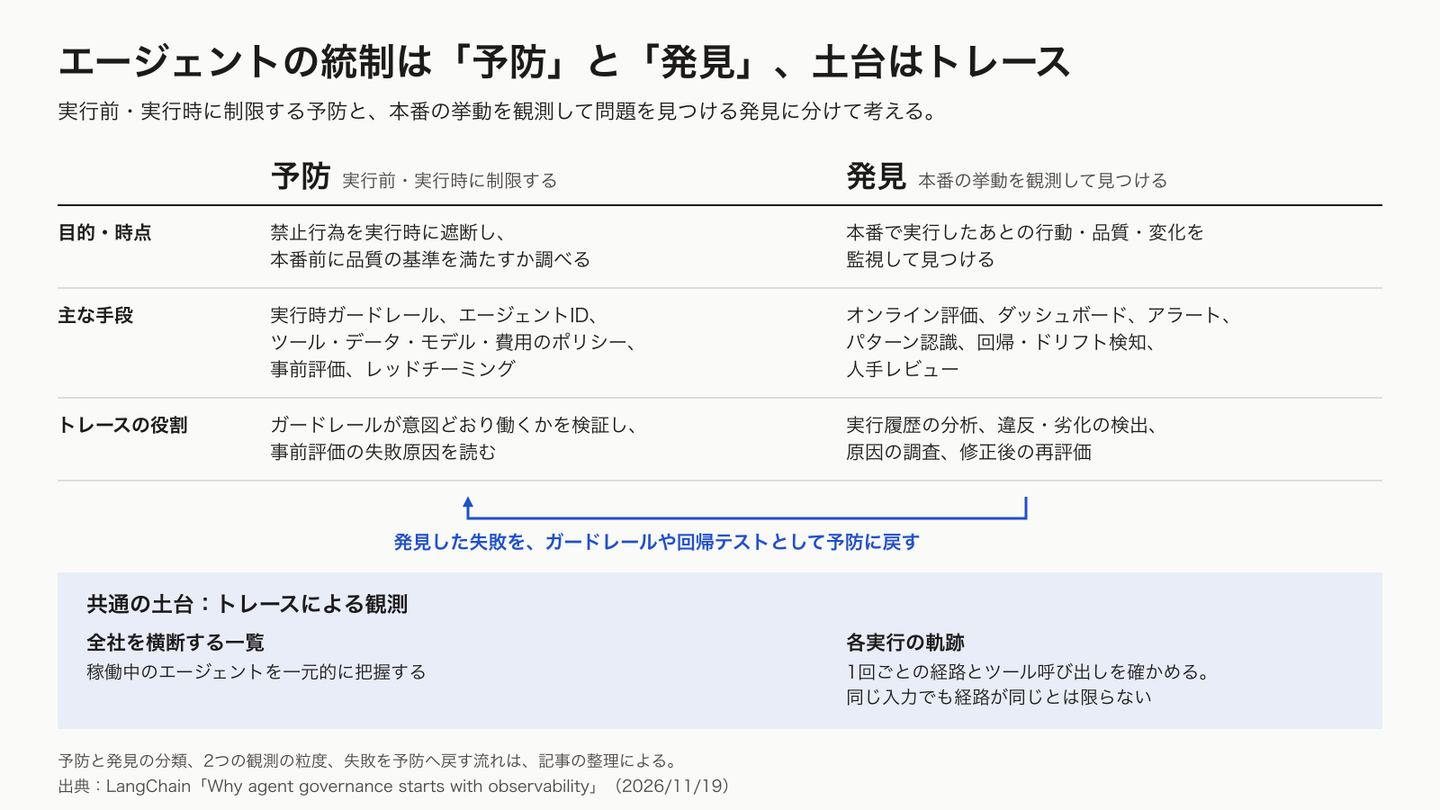
The article describes prevention as runtime guardrails (limits, agent identity, and policies on tools, data access, models, and cost) together with evaluation before production. Detection is monitoring after execution, and includes online evaluations, alerts, pattern recognition, human review, and regression and drift detection. The article then states that both depend on observability through traces (LangChain's article).
What to record first: traces and trajectories
The article distinguishes a trace, the detail of a single agent invocation, from a trajectory, a conversation-style view in which the actions within a session can be read in chronological order. It also names two levels of granularity for observation: a view that keeps a central picture of every agent running across the company, and a view that examines the full trajectory of each run. As the reason the latter is needed, it points out that giving the same agent the same input does not guarantee the same path or the same tool calls (LangChain's article).
Prevention: evaluation before production and runtime guardrails
As examples of prevention, the article cites redacting personally identifiable information (PII) before calling the LLM, and shutting down when a tool on a denylist is called. As a bar for evaluation before production, and framed as something a company might require, it gives the examples of a hallucination rate below 2%, no PII leakage, and correctness above 90% against human labels. These are hypothetical thresholds given for the sake of explanation, not the actual thresholds or achievement rates of companies that use LangSmith (LangChain's article).
Detection: monitoring behavior in production
As examples of detection, the article describes running online evaluations on production traces to look for PII leakage, excessive tool calls, and exposure of secrets. As things to alert on, it lists evaluation scores for hallucination and PII leakage, error rates, retries, and cost. It also describes a flow in which human reviewers score suspicious traces and examples that were handled properly are fed into reference data. These are operating practices that the article proposes, not measured results of adopting them (LangChain's article).
Feeding detected failures back into prevention
The article presents a cycle in which detected failures are fed back into stronger guardrails and additional regression tests. According to LangChain, LangSmith Insights automatically clusters traces, and LangSmith Engine analyzes failures and proposes fixes. However, the article does not show the effect or accuracy at any specific company (LangChain's article).
Near its end, the article says, in the context of more than 16,000 production agents deployed on LangSmith, that 87% of teams had tracing enabled before their first deployment. The 87% is a share of teams, not of agents, and it is LangChain's own tally. The total number of teams, the period covered, and how the sample was selected are not stated.
What Japanese companies should check when deciding on adoption
If you apply the article's framework to your own company, we recommend checking the following points.
- What to record. From the items the article lists, such as tool calls, errors, retries, and cost, decide which ones your company needs.
- Whether you can see both a company-wide list and the trajectory of each run.
- Whether you have set your own evaluation thresholds. The article's 2% and 90% are examples, not figures to use as they are.
- Who reviews suspicious traces, and how the failures you find are fed back into guardrails and tests.
Setting a policy and confirming that agents actually behaved according to that policy are separate tasks. Keeping records first, and then building a flow for reviewing them and fixing what you find, is the starting point for governance.
Elith provides GENFLUX Security, which shows who is using which AI and, based on internal rules, detects and blocks access to unapproved AI and the sending of confidential and personal information. Consider it when you begin your governance work by understanding how AI is being used inside your company.
To understand how AI is being used in your company, see Elith's GENFLUX Security.