
More companies are letting internal AI agents work with Gmail and Drive. Google has set out the Workspace AI Tools Addendum, terms that define the access path and data handling when AI agents access Google Workspace, and last modified it on November 24, 2026 (Workspace AI Tools Addendum). According to Google's usage tier documentation, the Addendum takes effect on February 1, 2027 (usage tier documentation). This article sorts out what was decided and how access from agents will change.
What the terms decided: agents use a Google MCP
The terms require a Google MCP when an AI agent, an AI harness, an AI model, or a tool driven by one of them accesses Workspace, and they prohibit avoiding this by disguising how the tool is classified. The scope is broad: besides agents that act on a person's behalf, it includes the layer that invokes tools and APIs (the terms, "Additional Definitions" and "Additional Terms" 1).
Google's announcement and the usage tier documentation point to the Workspace MCP servers and the Workspace CLI as the actual paths (Google Cloud announcement, usage tier documentation).
Three dates
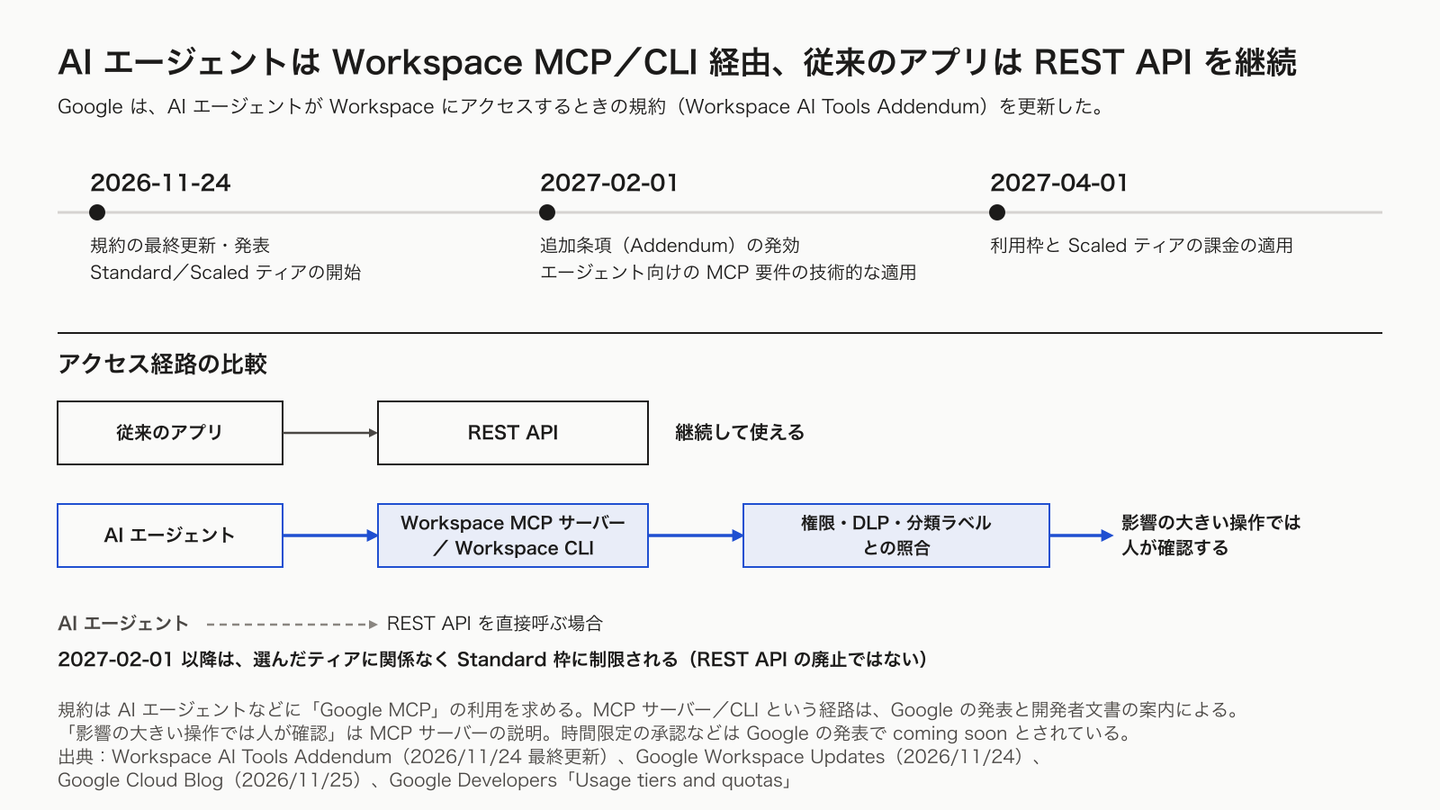
- November 24, 2026: The terms were last modified and announced. The Standard Tier and Scaled Tier officially launched.
- February 1, 2027: The terms take effect, and technical enforcement of the MCP requirement for agents begins.
- April 1, 2027: Scaled Tier billing and quota enforcement begin.
(usage tier documentation, "Rollout roadmap and key dates")
How access from AI agents will change
On November 24, Google announced general availability of the Workspace MCP servers and the Workspace CLI (Google Workspace Updates). The Google Cloud announcement dated the next day, November 25, lists eight products covered by the MCP servers (Gmail, Calendar, Drive, Docs, Sheets, Slides, Chat, and Tasks) and explains that every request is checked against the organization's Workspace permissions, DLP rules, and classification labels. The MCP servers build in human confirmation for sensitive actions and reject OAuth clients that are not for agents. Agents need dedicated OAuth client IDs (Google Cloud announcement, MCP configuration guide).
On the other hand, the same announcement describes time-limited approvals, users' ability to view agent activity themselves, and the extension of DLP and client-side encryption restrictions to agents as "coming soon" or otherwise still to come. Controls of the same strength are not yet applied to every action.
Traditional apps can keep using the REST APIs as before. However, starting February 1, 2027, when an AI agent or similar tool calls the REST APIs directly without going through MCP, it is limited to Standard Tier quotas regardless of the tier selected (usage tier documentation, "MCP requirement and direct REST API limits"). The REST APIs are not being discontinued.
On quotas, the Standard Tier MCP servers allow up to 5,000 requests per day, per project, per product, and require no billing account. From April 1, 2027, Scaled Tier usage of the Gmail, Calendar, and Drive MCP servers is billed from the first request (same document, "MCP server quotas"). Not all MCP usage becomes paid.
Data handling rules
The terms require that user data obtained through these tools not be stored in a manner prohibited by the API policies and not be used for any purpose other than active, user-authorized tasks. "Google Technical Information," such as embeddings, memory indexes, user profiles, and organizational graphs derived from access to Workspace, is treated separately from user data and may be stored for no more than 30 days. Neither may be retained after the tool is disconnected or its access is revoked. Use for model training, fine-tuning, building evaluation datasets, and similar purposes is also prohibited (the terms, "Additional Terms" 2).
AI agent security: what Japanese companies should check now
We recommend that companies connecting agents to Workspace check the following before February 1, 2027.
- Do you have a list of the agents that access Workspace and their paths (MCP, CLI, or direct REST API calls)?
- Have you prepared dedicated OAuth client IDs for agents?
- Do you know what data, such as embeddings and memory, your agents store and for how long?
- Does your usage fit within the Standard Tier quotas?
The wording of the terms, the implementation guidance, and the quotas are separate issues. The starting point is to check, one by one, which of them applies to your own integration.
At Elith, we offer GENFLUX Governance, which centrally manages information about the AI used in your company and its usage rules, and supports the preparation of the materials needed for C Certification (AI Governance Core Certification) and AIMS audits. It manages records such as the AI inventory, rules, risks, and approvals, and can serve as a starting point for sorting out which AI is used for which work in your company.
For managing AI usage rules, see Elith's GENFLUX Governance.