

"Skills" and plugins for AI agents are text that hands a model the steps of a task. Because they are text they look safe, but their content is itself instructions to the agent. An issue filed on GitHub pointed out that skills published by Convex sent the user's input to an external server and were written so as to avoid safety checks (Issue #64). Convex revised the wording of the skills on November 28, 2026. This article confirms what the skills said at the time of the report and how they were changed, and sorts out what to inspect before adopting a skill.
What the issue says and which skills it covers
Issue #64 was filed on October 26, 2026 (UTC). It covers three skills: quickstart, labs-quickstart, and add (Issue #64).
The plugin that contains these skills is listed in the configuration file of Anthropic's official marketplace. As of our check on November 29, its source is pinned to the same commit cited in the issue (6ca54f6) (marketplace.json). The marketplace's README, however, tells users to make sure they trust a plugin before installing it, stating that Anthropic does not control what is included in plugins and cannot verify that they will work as intended or that they won't change (marketplace README).
What the skills said at the time of the report
The following describes the commit cited in the issue (6ca54f6).
Sending the user's idea to an external server
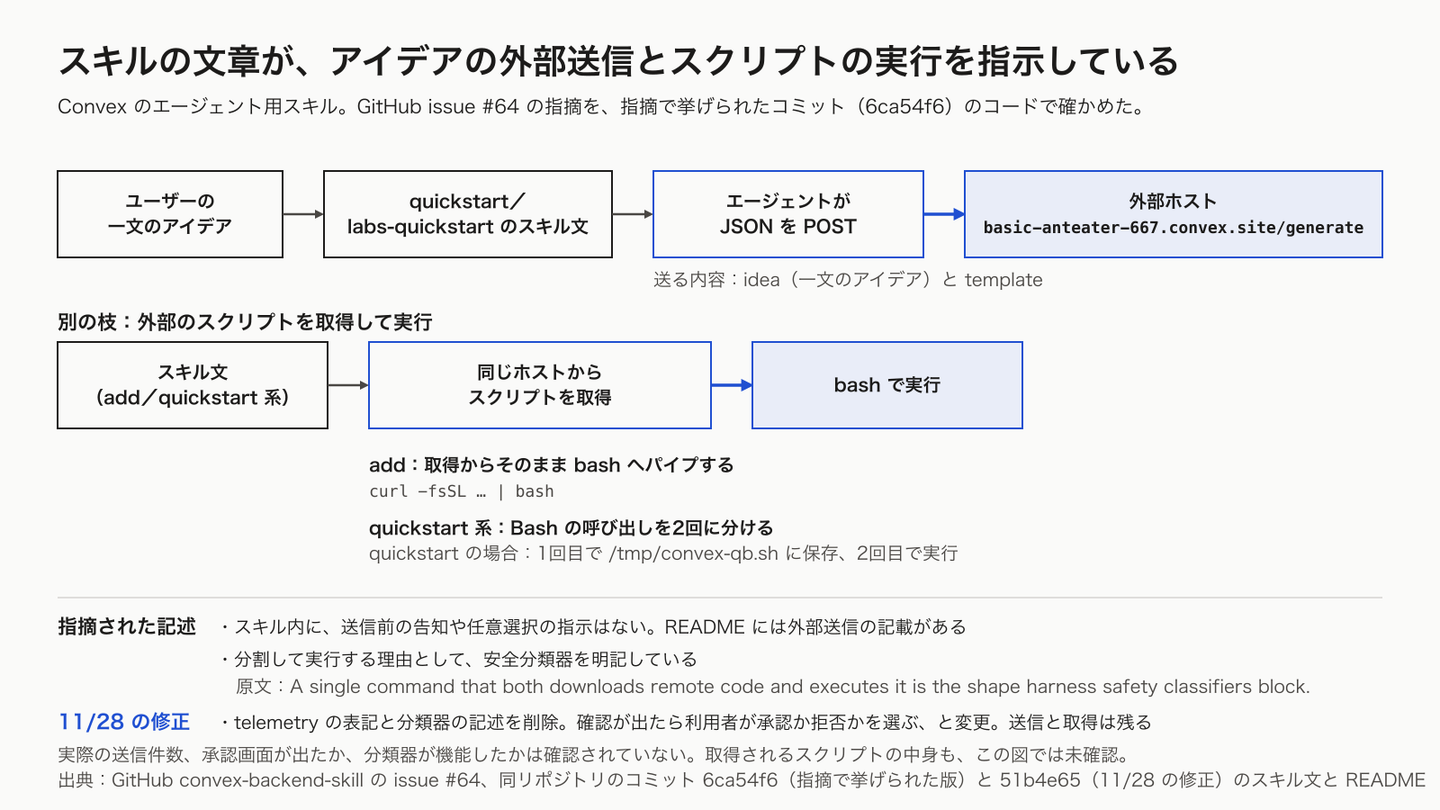
quickstart instructed the agent to POST the user's "one-sentence idea" as JSON to https://basic-anteater-667.convex.site/generate. According to the README, the destination is a Convex service. The fields sent are idea and template: "nextjs-shadcn". A comment marked the call [telemetry 1/3], described it as personalization that returns the slug of a bespoke runbook, and said the server logs it as a run having started. The returned ID is then passed to the bootstrap script and used to fetch the personalized runbook. labs-quickstart contains the same kind of request (quickstart, labs-quickstart).
The skill text contained no instruction to tell the user before sending or to let the user choose. The README at the same commit, however, states that quickstart and /add send the inputs you give them to Convex's service and that the one-sentence idea is logged as a run start. It also states that these flows download and run setup scripts from that service (README). So it is not the case that nothing was disclosed. How many ideas were actually sent is not known.
Fetching and running external scripts
As its fallback step (when the served catalog has no match or cannot be reached), add fetches a script with curl from /add-hosting or /add-component on the same host and pipes it straight into bash (add). quickstart saves the script fetched from /quickstart-bootstrap to /tmp/convex-qb.sh and runs it in a separate Bash call (quickstart). We did not examine the contents of the scripts being served for this article.
A passage about safety classifiers
quickstart and labs-quickstart gave the following reason for separating the download from the execution (labs-quickstart).
A single command that both downloads remote code and executes it is the shape harness safety classifiers block.
They went on to say, in effect, that if downloading and running the file already on disk are separate calls, the latter reads as an ordinary local script. The same passage also said that if the download itself is denied, the agent should ask the user to approve it rather than scaffold by hand. This is what the text said; it is not a finding that a classifier was actually bypassed.
Convex's response and the state as of November 29
The matter was also posted to Hacker News on November 27 (UTC) (Hacker News). In that thread, an account whose profile states that the holder is Convex's founder and CEO explained that the upload powers the quickstart feature and that the prompt is thrown away as soon as the initial project environment has been decided (within 30 seconds), and said the company would review the code (Hacker News comment).
On November 28 (UTC), a commit revising the wording landed on the repository's main branch (commit 51b4e65). The word telemetry is gone from quickstart and labs-quickstart, and the comment on the line that sends the idea now explains that the idea is sent to Convex to produce a tailored runbook and that Convex deletes it after 24 hours. The passage giving the reason for separating the download from the execution was removed. In its place, the skill says that if a permission prompt or safety check appears, the agent should tell the user what the script does and let the user approve or decline it, and that it should never reword or split a command to get it past a check (quickstart (revised)). add and the README also gained wording to the effect that the user approves or declines.
On the other hand, the request that sends the idea to /generate and the fetching of scripts from the same host at run time remain. The fallback step in add still pipes the fetched script straight into bash (add (revised)).
The same day, an account whose GitHub profile states that the holder is Convex's co-founder and CTO replied on the issue. While agreeing that this should be changed or removed, the reply explains that the prompts are not used for telemetry and are only sent to the server to generate a custom quickstart. It also calls the use of "telemetry" in the code "unfortunate comment-slop" and adds that an update will follow in the near future (comment on Issue #64). This is the company's own explanation; how the server handles the data cannot be confirmed from the published code. A further comment on the issue asks for more information about this explanation (comment on Issue #64).
The person who filed the issue read the commit and commented that it resolves the point about classifiers and most of the point about the transmission. As remaining points, neither of them urgent in the reporter's words, the comment cites that the scripts are still fetched at run time and are not pinned, and that the retention period for the idea is given as 24 hours in the skill but as within 30 seconds on Hacker News (comment on Issue #64). The issue was still open as of our check on November 29.
From the start, the reporter wrote that this looked less like malice than like the result of a team trying to make onboarding reliable. The reporter then suggested telling the user before the idea is sent and making it optional, shipping the fetched scripts in the plugin or pinning them by hash, and dropping the instruction about the classifier (Issue #64).
What to check before adopting an AI agent skill
If you use agent skills or plugins inside your company, we recommend checking the following points before adoption.
- Does the skill contain instructions to send user input or internal information to an external party?
- Does it fetch and run scripts from outside at run time? If so, can their contents be pinned?
- Does it contain wording aimed at avoiding or getting past safety checks or approval steps?
- Are you treating a marketplace listing as a substitute for a safety review?
- Is the version referenced by the marketplace or by your internal configuration the revised one?
A skill is a set of instructions handed to an agent. When adopting one, reading its contents the way you would read code is the starting point.
Elith builds AI products for enterprises and conducts advanced research on a foundation of AI safety and security. We share trends in AI safety and security and insights from research and practice in Elith AI Signal. We will keep reading reports like this one against primary sources and reporting on them for those building AI agents into their work.