When you use a managed cloud, a breach on the provider's side can reach your own environment, and the service itself can come to an end. Rackspace announced that, following the recent security incident affecting Spot, it will wind down Spot on December 8, 2026 (Rackspace Spot status page). The evidence in this case comes in different kinds: the provider's notice, a customer notification seen by the press, and a post by a person involved. This article separates what can be confirmed from each.
What the provider announced: the wind-down and access to data
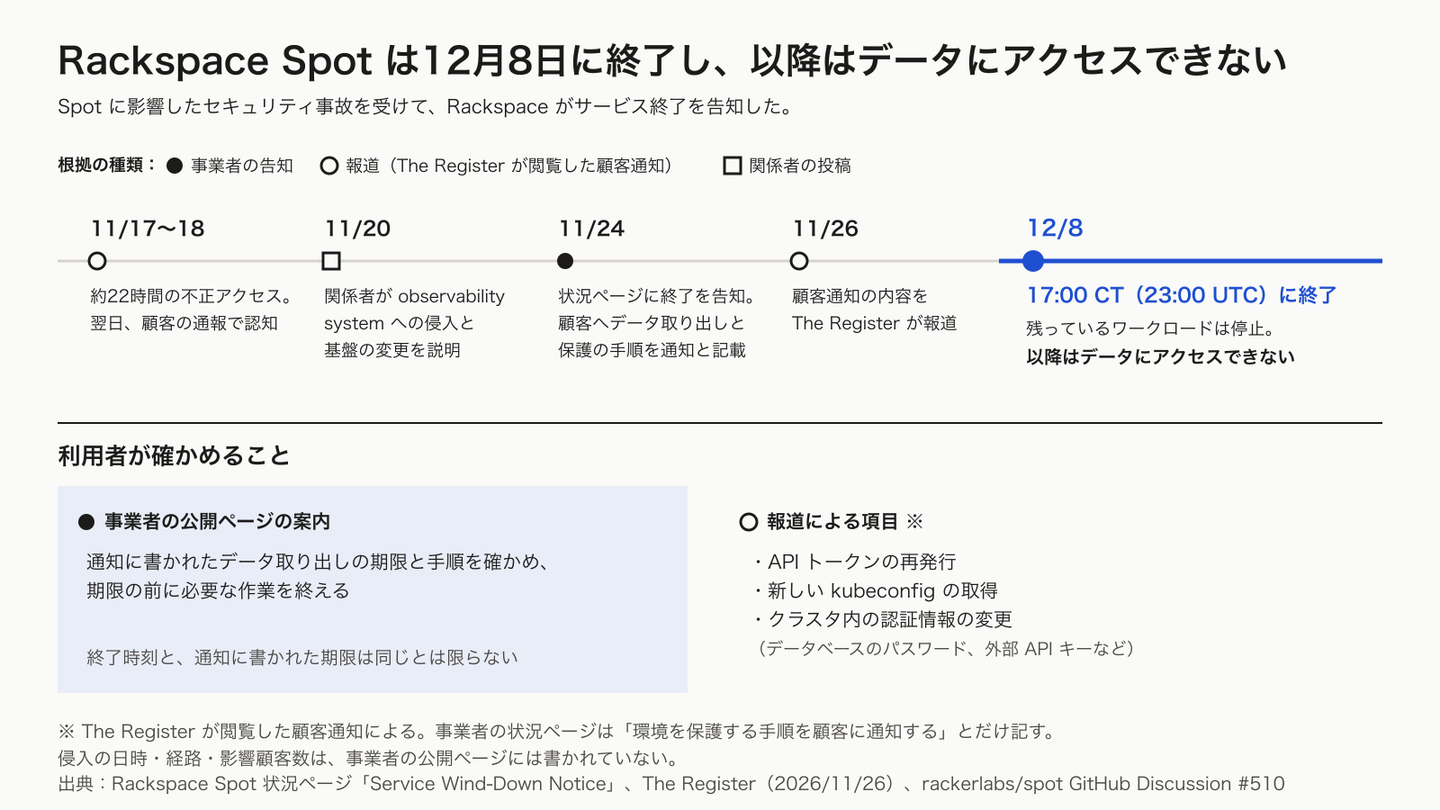
According to Rackspace's status page, Spot will be wound down at 17:00 on December 8 (U.S. Central Time). That is 23:00 in Coordinated Universal Time, a conversion The Register also gives (Rackspace Spot status page, The Register's article).
The same page says that any workloads still running will be terminated on that date and that customers will no longer be able to access their data afterward. It also says customers are being notified of the wind-down timeline, instructions for retrieving their data, and steps to secure their environments, and it urges them to complete the required actions before the data-retrieval deadline stated in those notices (Rackspace Spot status page). For this reason, we cannot say that the wind-down time on December 8 is a migration deadline common to all customers.
The status page does not state when the incident occurred, who the intruders were, how they got in, or how many customers were affected.
What the press reports about the customer notification
On November 26, The Register reported on the contents of the notification sent to customers. According to the customer notification seen by The Register, there was unauthorized access lasting about 22 hours on November 17, and it came to light the following day, November 18, through a customer's report. The intruders are said to have used leaked credentials to access parts of Spot, impersonated legitimate users to create pods in customers' clusters, accessed Kubernetes Secrets, and listed nodes and storage volumes (The Register's article).
The notification explains that the intruders could have read the Secrets in an affected user's clusters and any Spot API token or refresh token that user held. The article does not tell us which Secrets were actually read or whether anything was taken outside.
According to the same notification, Rackspace revoked the affected tokens and sessions, removed the intruders' pods, and changed the platform and storage keys. Customers are reported to have been asked to reissue API tokens, download new Kubernetes configuration files, and change the credentials stored in their clusters, including database passwords and third-party API keys (The Register's article).
A public comment from a person involved
In Spot's GitHub Discussions, a person involved posted on November 20 that an observability system had been breached using a compromised credential, and explained that major changes to the underlying infrastructure clusters were needed and were prolonging the outage (GitHub Discussion #510). The Register introduces this poster as an executive of Platform9, the company that co-developed Spot. This is not a formal incident report, and it does not show the full attack path or how the first credential was leaked.
What has not been made public
The number of affected customers, how many Secrets were actually read and whether any were taken outside, the detailed reasons for choosing to end the service, and whether there will be compensation or deadline extensions have not been made public in the public materials we could confirm as of November 27, 2026. The specific date and time of the data-retrieval deadline stated in the notices cannot be confirmed from public materials either.
What Japanese companies should check to prepare for cloud security incidents
Companies using Spot should first check the data-retrieval deadline and instructions stated in the notice addressed to them and finish the work before that deadline. Going by the notification as reported, changing API tokens, configuration files, and the credentials in their clusters is also something to check.
For companies using other managed clouds, the following points are also worth checking.
- Who receives notices of a provider's breach or shutdown, and where do you verify them?
- Do you have a list of the credentials stored in your clusters, and can you change them right away?
- If a provider announces a shutdown, do you have a procedure and a destination ready for moving your data?
The provider's notice, press reports, and posts by people involved differ in how firmly their contents can be confirmed. Reading the evidence separately, confirming the wind-down date and time from the provider's notice and the deadline and instructions from the notice addressed to you, is the starting point for avoiding confusion.
Elith builds AI products for enterprises and conducts advanced research on a foundation of AI safety and security. We share trends in AI safety and security and insights from research and practice in Elith AI Signal. We will keep reading announcements like this one against primary sources and reporting on them.