

Before PDFs and scanned documents can be handed to AI agents or retrieval-augmented generation (RAG), a preprocessing step has to extract text and tables correctly from the page images. On November 26, 2026, NVIDIA described three synthetic training datasets, its training procedure, and speed measurements with the speculative decoder "DFlash2" for Nemotron 3.5 Parse, a model that extracts text, tables and charts, reading order, semantic classes, and positions from document page images (NVIDIA's article). This article sorts what was published into three parts: data, training, and inference.
The published training data: three synthetic datasets
The three synthetic datasets below were published. All of them are image/annotation pairs, not counts of real documents.
- Synthetic Charts V1: 9,980,000 chart image/annotation pairs (dataset card)
- Synthetic Tables V1: 1,000,000 table image/annotation pairs (dataset card)
- OCR Synthetic Multilingual v2: 7,907,809 pairs for multilingual text recognition (dataset card)
Together, the three come to 18,887,809 pairs (calculated from the values on the cards). The multilingual dataset card lists "149 language/script entries across 28 scripts" as its coverage (dataset card). That describes what the data covers; it does not show that accuracy is high in all 149 languages.
The training procedure: SFT, then reinforcement learning with GRPO
According to NVIDIA, supervised fine-tuning (SFT) first taught the model to produce structured output for text, layout, tables, charts, and multilingual documents. It then continued with reinforcement learning with verifiable rewards (RLVR), using GRPO. Examples of rewards include recovering the correct chart series and values, producing a usable structure, and finishing without repeatedly generating the same content (NVIDIA's article, fine-tuning recipe).
In a reference comparison of development checkpoints on the same 2,078 pages with the same scorer, moving from SFT to GRPO changed the overall score from 66.24 to 71.38, the number of loop-flagged pages from 126 to 29, and the number of pages reaching the 9,000-token cap from 185 to 35. This is not a comparison with the final released model (measurement notes).
Faster inference: the DFlash2 speculative decoder
With DFlash2, a small draft model proposes up to 32 tokens ahead, and the Parse model verifies the proposals together. NVIDIA explains that in the 32-token configuration, an average of about 14 draft tokens are accepted, for roughly 15 tokens of progress per verification step (NVIDIA's article).
Speed was measured on the 2,078 pages of ParseBench. The conditions were one H200, BF16, a single pass, and the median of three trials at each point. The baseline was the same Nemotron 3.5 Parse without speculative decoding. At concurrency 1, throughput went from 0.54 to 4.10 pages per second (7.62×); at concurrency 512, from 13.48 to 20.44 pages per second (1.52×) (measurement protocol and data).
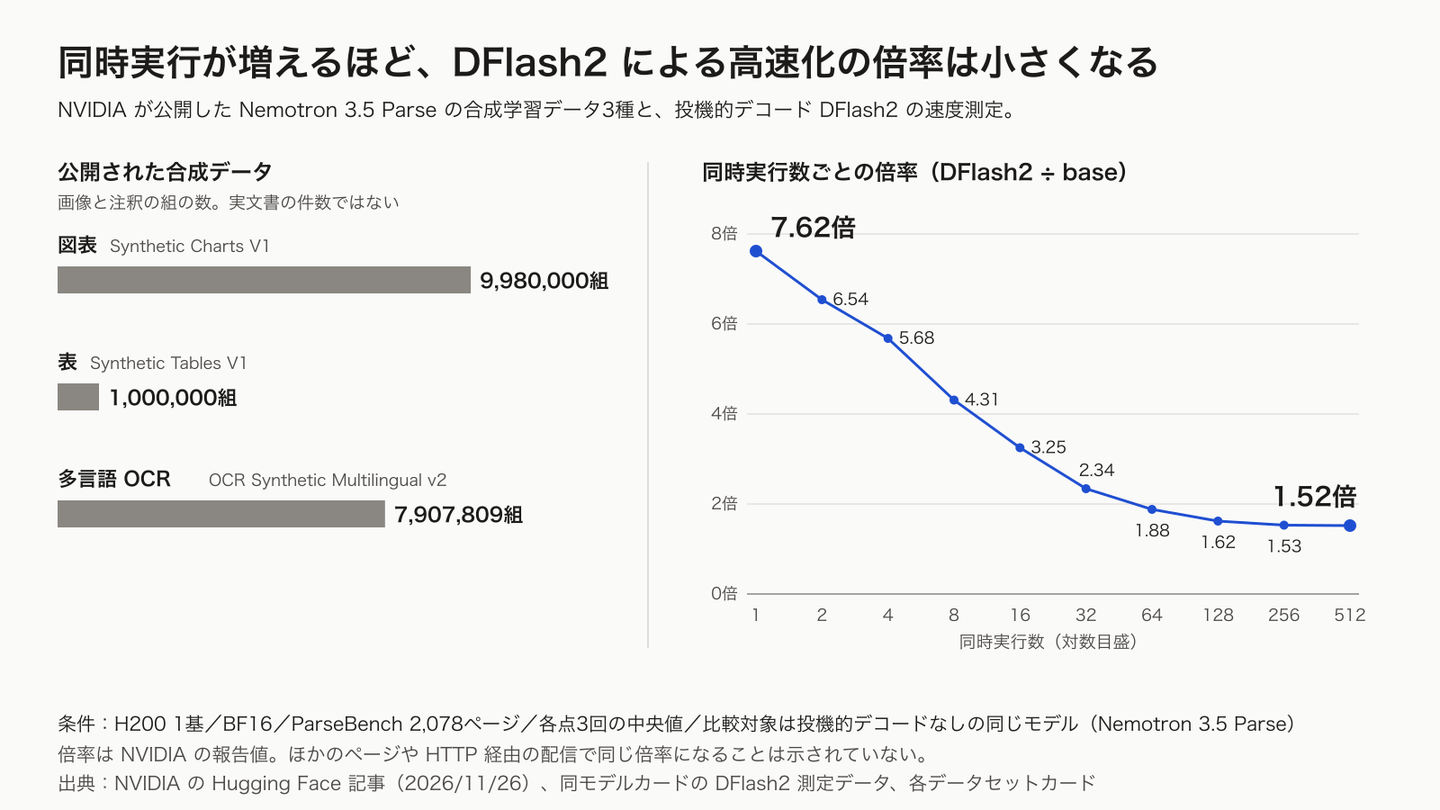
The speedup falls as more requests are processed at the same time. The measurements also exclude model startup, image loading, output serialization, and HTTP (measurement notes). Nothing shows that the same speedup holds for other documents or serving setups.
Terms for the published materials
The model card states the OpenMDW License Agreement v1.1 for the model and MIT for the bundled tokenizer (model card). The three dataset cards, however, show CC BY 4.0 in their header metadata, while their text says, "A dataset-wide reuse license has not yet been assigned" (Synthetic Charts V1 and the others). Check the rights before you use them.
What Japanese companies should check before adopting
If you plan to use document-parsing AI in your business, we recommend checking the following.
- Have you measured accuracy on your own documents (forms, charts, languages)? The published data is synthetic, and the counts are not numbers of real documents.
- Have you measured speed at your own concurrency, in a setup that includes startup and networking? The 7.62× figure is for concurrency 1.
- Have you confirmed the terms of the datasets and the model with your legal team?
The accuracy and speed of preprocessing shape the results of the RAG and agents that follow. Read the published numbers as reference values that come with conditions, and start by checking them on your own documents.
At Elith, we will keep reading public information like this from the primary sources and sharing it with people who are building AI into their work.