

Checkout pages on online stores load a lot of third-party code, such as advertising pixels and consent banners. On November 27, 2026, InfoHawk reported that it had found code targeting card details on five online stores in the week before Black Friday (InfoHawk's report). The code used a WebRTC data channel to carry additional code and data. This article separates what happened from what has actually been confirmed, and summarizes the measures site operators can take.
What happened: five online stores and the code that served as the entry point
According to InfoHawk, the affected sites were Lascana, Samsonite, American Tourister, Revolve, and FWRD. The entry point was an altered Quorum marketing pixel at Lascana, an edited Seers cookie-banner setting at Samsonite and American Tourister, and an altered file on Revolve's own CDN at Revolve and FWRD (InfoHawk's report, "Which sites were affected").
InfoHawk says it notified the parties on November 24 and that the code was removed on November 24 or 25. According to its article, Lascana removed the Quorum pixel by 15:48 UTC on November 24, and Quorum confirmed that the malicious code had been removed and restored the clean pixel as of 21:09 UTC. The code on Samsonite and American Tourister was removed at 14:25 UTC the same day, but neither the retailers nor Seers replied to InfoHawk. The statement from Revolve that InfoHawk published says the company was notified on November 25, resolved the issue the same day, and is investigating any potential impact.
The only case in which InfoHawk observed card details being sent off-site was its own test card at Lascana. The company writes that it does not know whether any real shoppers' details were captured or, if so, how many.
How the attack works: seven steps
InfoHawk describes the behavior in seven steps (InfoHawk's report, "How the attack works").
- The planted loader gets onto the page.
- It loads
Insds.jsorgtage.jsfrom an Amazon S3 bucket. - It runs only on small or touch screens (the Samsonite version runs on
/checkoutonly). - It sends
GET /_cf/iceto anorthbridgeads[.]comhost to fetch the relay details, and sends the WebRTC offer withPOST /_cf/rel. - It exchanges data over a data channel through the TURN relay at
turn.cloudflare.com. - It receives the skimmer in chunks, checks it against a SHA-256 digest, and runs it with
eval. - It sends the card details back over the same channel.
InfoHawk believes the script was built to take the card number, expiry, and security code, along with details such as name and address, before the store checked the payment.
turn.cloudflare.com is the endpoint of the TURN service that Cloudflare provides (Cloudflare's documentation). InfoHawk's report says the attack traffic ran through this relay; it does not say that Cloudflare was compromised.
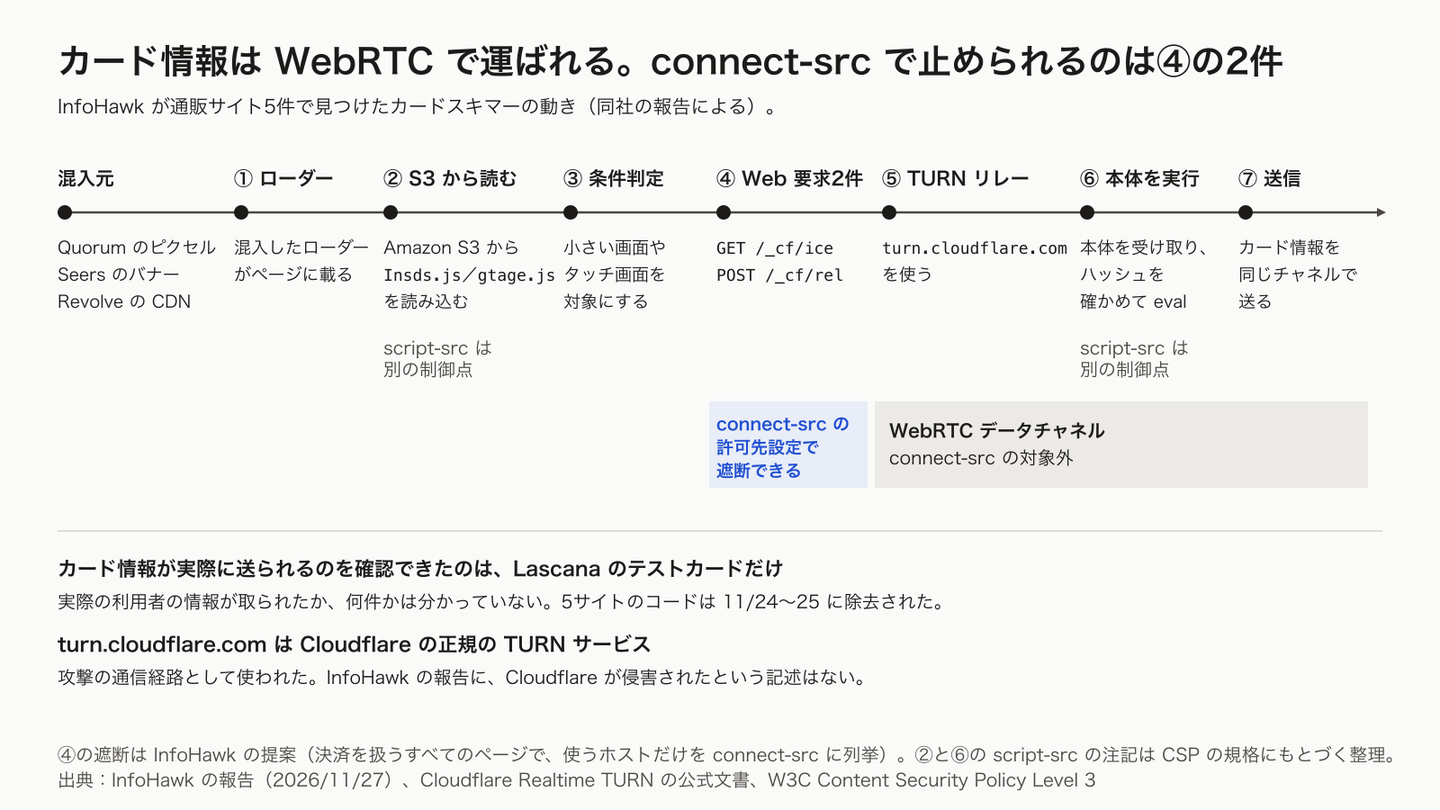
What CSP's connect-src can block
What InfoHawk explicitly says connect-src can block is the two ordinary web requests in step 4. Steps 5 to 7 run over the WebRTC data channel, outside this directive.
Loading the script from S3 in step 2, on the other hand, is a matter for script-src, which governs where scripts may be loaded from. The eval in step 6 also relates to the unsafe-eval setting of script-src (W3C CSP Level 3). The same specification also defines a webrtc directive that controls whether WebRTC connections may be established (W3C CSP Level 3). The specification is a Working Draft dated October 27, 2026, so browser support needs to be checked before relying on it.
These points are based on the CSP specification; we have not verified the actual policies of the five sites or whether anything was blocked there.
Measures site operators can take
InfoHawk recommends setting, on every page that takes payment, a connect-src rule that lists only the hosts you use. It says this blocks the two requests in step 4 that the script needs before WebRTC opens (InfoHawk's report, "What site owners should immediately do").
The company also says that card fields should sit in an isolated payment frame and that third-party tags should be kept off login and payment pages (same report, "The industry is not ready for the scale of supply chain attacks coming").
What operators should check for e-commerce site security
We recommend that companies operating online stores check the following points.
- Have you listed the third-party tags loaded on your checkout pages and removed the ones you do not need?
- Have you narrowed
connect-srcandscript-srcon your checkout pages to the hosts you use? - Are your card fields placed in an isolated payment frame?
At three of the five sites, the entry point was a third-party pixel or a consent-banner setting. Knowing what code runs on your checkout pages is the starting point for defense.
Elith builds AI products for enterprises and conducts advanced research on a foundation of AI safety and security. We share trends in AI safety and security and insights from research and practice in Elith AI Signal. We will keep reading reports like this one against primary sources and reporting on them.