
When you use generative AI APIs through a router, the provider name shown on screen and a ZDR (zero data retention) label may not tell you where a request was actually processed. In late November 2026, several inference API providers announced, one after another, that they had processed users' requests on another company's official API. Around the same time, an independent researcher published an investigation pointing to a different route. This article separates what providers have acknowledged from what the researcher's investigation indicates.
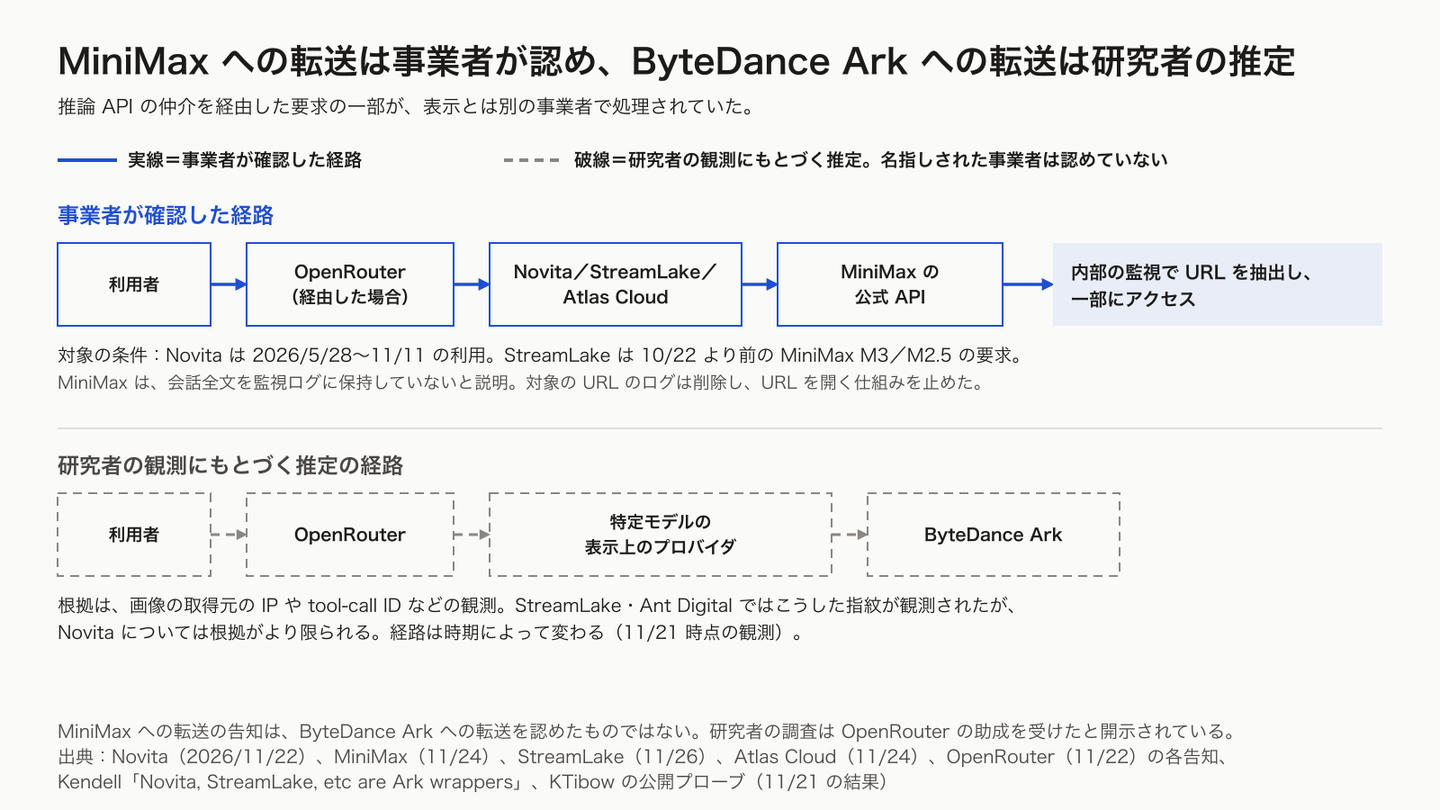
What providers acknowledged: forwarding to MiniMax's official API
On November 22, Novita announced that a forwarding configuration intended for specific customers had mistakenly been applied more broadly, and that some requests to MiniMax models were processed on MiniMax's official API rather than on Novita's infrastructure. Those affected are users who used MiniMax models through Novita between May 28 and November 11, 2026, both directly and via OpenRouter. Novita recommends revoking or rotating secrets and API keys if they were included in requests (Novita's notice; if it does not open, see the archived copy).
StreamLake also explained that a configuration error had caused MiniMax-operated capacity to be routed into two of its endpoints (MiniMax M3 and M2.5), and that requests made to those two endpoints via OpenRouter before October 22, 2026 may have been affected (StreamLake's notice). Atlas Cloud has likewise acknowledged that it used MiniMax's official API (Atlas Cloud's notice). The affected periods and models differ by provider.
MiniMax's automated opening of URLs
On November 24, MiniMax explained that, for some requests that reached it directly from OpenRouter or through providers such as Novita, StreamLake, and Atlas Cloud, its internal monitoring extracted and logged IP addresses and URLs, and that subsequent automated analysis accessed some of those URLs. This monitoring was enabled by default on the routes in question, and the requests included ones that OpenRouter had identified as ZDR or no data collection (MiniMax's notice).
MiniMax says it has stopped the mechanism that opened URLs and deleted the URLs recorded from the affected requests from its security logs. What it deleted is the log of those URLs; it says it retains usage records for billing and service operations. It also says that this monitoring log did not keep full conversations and that, for the requests it examined, it found no evidence that prompts or responses were disclosed to third parties beyond the URL activity. This is an explanation within the scope of the company's own investigation.
OpenRouter announced that, across multiple inference providers, it had off-boarded three providers and removed 125 endpoints from ZDR eligibility. These numbers cover the whole series of investigations, not the MiniMax case alone (OpenRouter's announcement).
What the researcher's investigation indicates: a route to ByteDance Ark
Separately, an independent researcher reports observing characteristics of ByteDance's Ark on some models that OpenRouter listed under other providers (the researcher's investigation). According to the published measurement record, in the November 21 run, StreamLake's DeepSeek V4.1 Flash showed Ark-style tool-call IDs and image downloads from a Beijing Volcano Engine network (measurement record). For Novita, this run alone does not directly confirm where the images were downloaded from, so the strength of the evidence differs by provider.
The researcher also writes that routes change and that some of these characteristics were no longer seen by November 24. The post discloses that the research was supported by a grant from OpenRouter. As of November 27, 2026, we have not been able to confirm any official statement in which the named providers acknowledge this route.
What companies should check to prevent data leaks from generative AI
We recommend that companies using generative AI APIs in their work check the following.
- Are you putting secrets such as API keys or passwords in prompts? If you were, consider revoking and reissuing them.
- Does your provider disclose which companies it entrusts processing to (its sub-processors)?
- Have you checked whether a label such as ZDR actually guarantees the retention and monitoring conditions at the place where requests are really processed?
- For highly confidential uses, have you considered contracting directly with the model's provider or hosting the model yourself?
What a router displays and where a request is actually processed do not always match. The starting point is to read providers' notices and researchers' observations separately and choose a route that fits your own use.
At Elith, we offer GENFLUX Security, which shows who is using which AI and, based on your internal rules, detects and blocks access to unapproved AI and the sending of confidential or personal information. It is available as a browser extension and a desktop version, and you can set warnings, blocking, and masking for information such as payment and authentication data and company-specific confidential information. It is not a product for examining how API requests are forwarded, but it can be used as one measure to keep employees from entering secrets into generative AI.
For preventing data leaks from generative AI, see Elith's GENFLUX Security.