
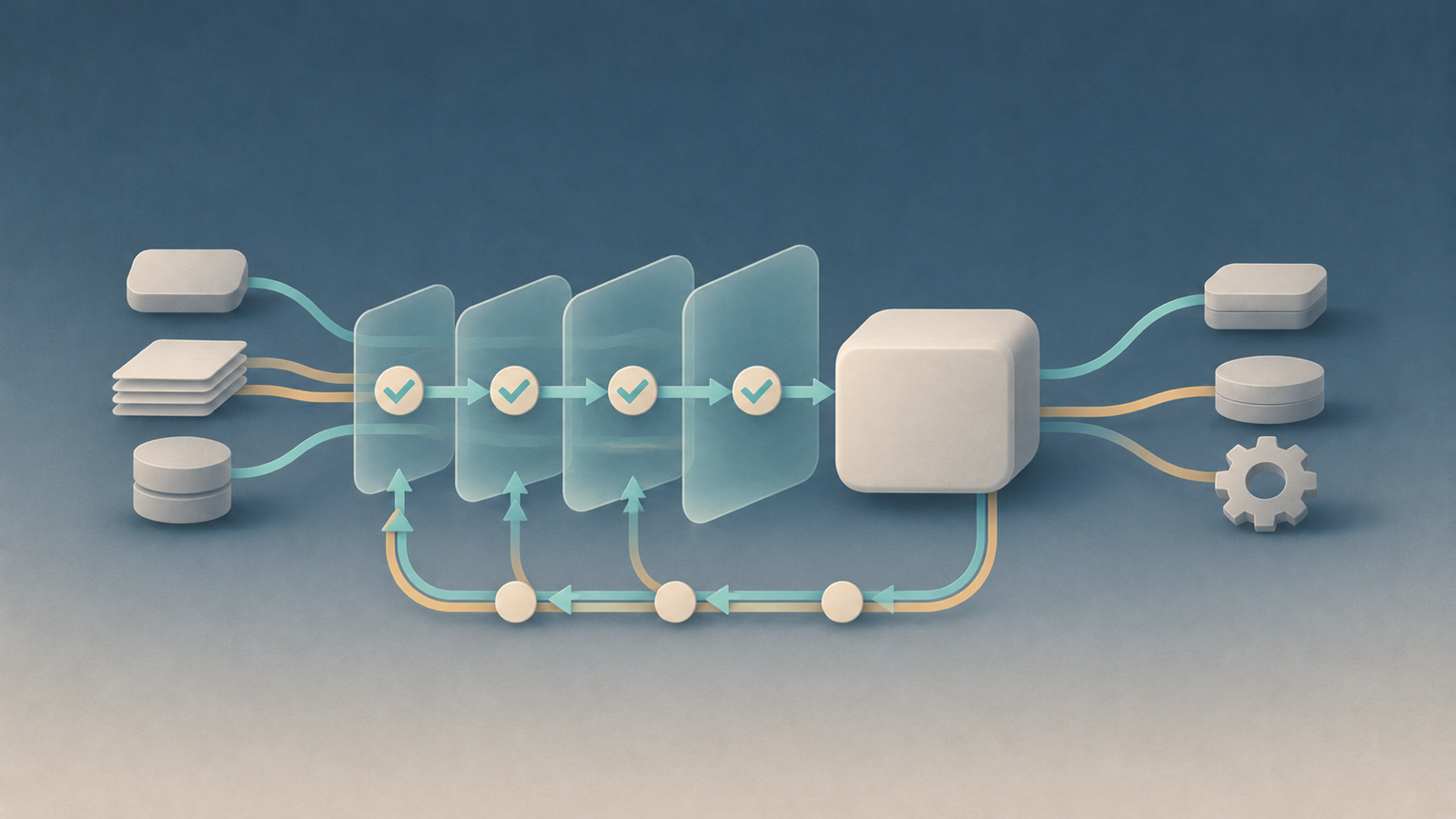
Generative AI security requires separate treatment of four areas: managing the information users enter into AI, managing the boundary where LLM apps handle external documents and data, managing the permissions with which AI agents run tools, and continuously evaluating whether the countermeasures work. Based on the OWASP 2026 classification and Japanese government documents, this article lays out the risks of and countermeasures for prompt injection, information leakage, and AI agents, and explains what companies should check when deciding whether to adopt them.
Main AI security risks: the OWASP 2026 classification
OWASP's "Top 10 for LLM Applications 2026" classifies the risks of LLM applications into the following 10 items (OWASP Top 10 for LLM Applications 2026).
- LLM01 Prompt Injection
- LLM02 Sensitive Information Disclosure
- LLM03 Excessive Agency
- LLM04 Supply Chain
- LLM05 Data and Model Poisoning
- LLM06 Unbounded Consumption
- LLM07 Misinformation
- LLM08 Hidden Context Exposure
- LLM09 Vector and Embedding Weaknesses
- LLM10 Improper Output Handling
This is a classification of risks. It is not statistics showing how often they occur at individual companies or how well countermeasures have been implemented.
Note also that the item numbers have changed from the 2025 edition. For example, improper output handling is LLM10 in the 2026 edition (OWASP Top 10 for LLM Applications 2026).
For AI agents, OWASP's "Top 10 for Agentic Applications 2026" lists the following 10 items (OWASP Top 10 for Agentic Applications 2026 p.8).
- ASI01 Agent Goal Hijack
- ASI02 Tool Misuse and Exploitation
- ASI03 Identity and Privilege Abuse
- ASI04 Agentic Supply Chain Vulnerabilities
- ASI05 Unexpected Code Execution
- ASI06 Memory & Context Poisoning
- ASI07 Insecure Inter-Agent Communication
- ASI08 Cascading Failures
- ASI09 Human-Agent Trust Exploitation
- ASI10 Rogue Agents
As a risk management framework, there is NIST AI 600-1, published on July 26, 2024. It is the generative AI profile of AI RMF 1.0, and is a document that can be used voluntarily in any sector (NIST AI 600-1).
Direct and indirect prompt injection
OWASP distinguishes direct attacks, which use input given directly to the AI by users and others, from indirect attacks, which come through web pages, documents, emails, search and RAG results, tool outputs, and the like. It also states that images, audio, video, and persistent memory can be attack surfaces as well (OWASP LLM01:2026 "Types of Prompt Injection").
The Ministry of Internal Affairs and Communications (MIC) "Guidelines on Technical Measures for Ensuring AI Security" (March 2026) likewise defines direct injection as entering a crafted prompt and indirect injection as having the AI refer to crafted data (MIC Guidelines p.7 "2.1.1").
Prompt injection countermeasures
OWASP states plainly that there is no mechanism that reliably prevents prompt injection, and recommends assuming a breach and applying structural restrictions (OWASP LLM01:2026 "Prevention and Mitigation Strategies"). The MIC guidelines also state that it is difficult to eliminate the causes completely with any single measure, and list validation of input, external reference data, and output, as well as least privilege for the orchestrator and RAG (MIC Guidelines p.12 "3.1", p.13 Table 2, p.15 "3.4").
The approach is not to assume that detecting banned words or separating the system prompt is enough. Instead, validate what comes in, what is referenced, and what goes out, and use permissions to limit the range of possible damage.
AI agent security: minimize permissions
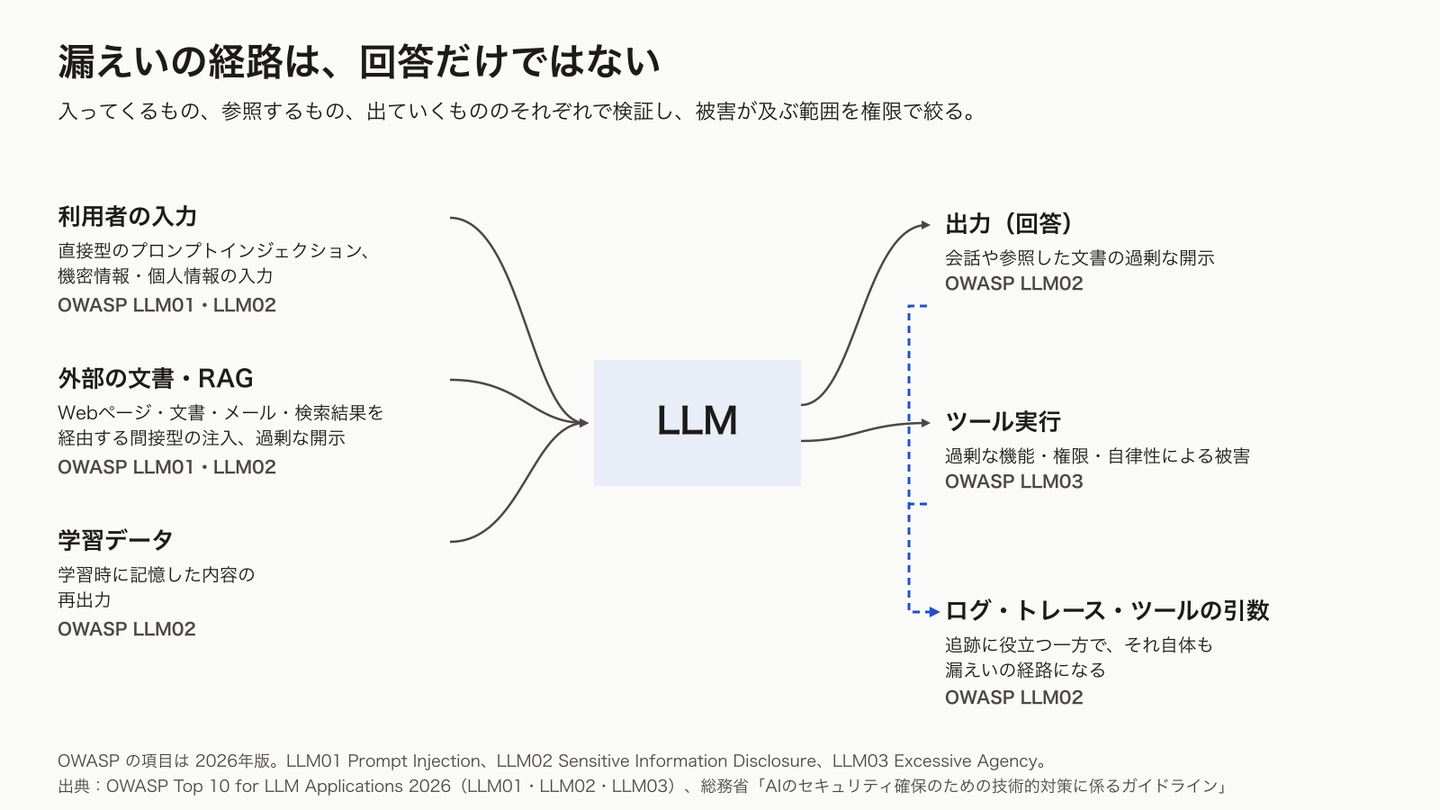
OWASP names excessive functionality, permissions, and autonomy as the root causes of excessive agent actions. As countermeasures, it indicates minimizing the tools and functions available, avoiding general-purpose tools such as free-form shell execution, and narrowing the permissions of the systems the tools connect to. When acting on behalf of a user, the agent should stay within the scope of that user's permissions, and a human should approve high-impact operations. Authorization should not be left to the LLM's judgment; it should be verified every time in the logic of the tools and downstream systems. OWASP also lists execution logs and rate limiting as measures to limit damage (OWASP LLM03:2026 "Root cause", "Prevention and Mitigation Strategies").
OWASP's Agentic Top 10 treats goal rewriting through external data, tool misuse, privilege abuse, memory poisoning, and inter-agent communication as separate attack surfaces (OWASP Top 10 for Agentic Applications 2026 p.8–10, p.12–17, p.24–29). This means placing validation, authorization, approval, and logging at each boundary in the flow in which an agent reads external data, reasons, runs tools, and operates external systems.
Generative AI information leakage countermeasures: the answer is not the only path
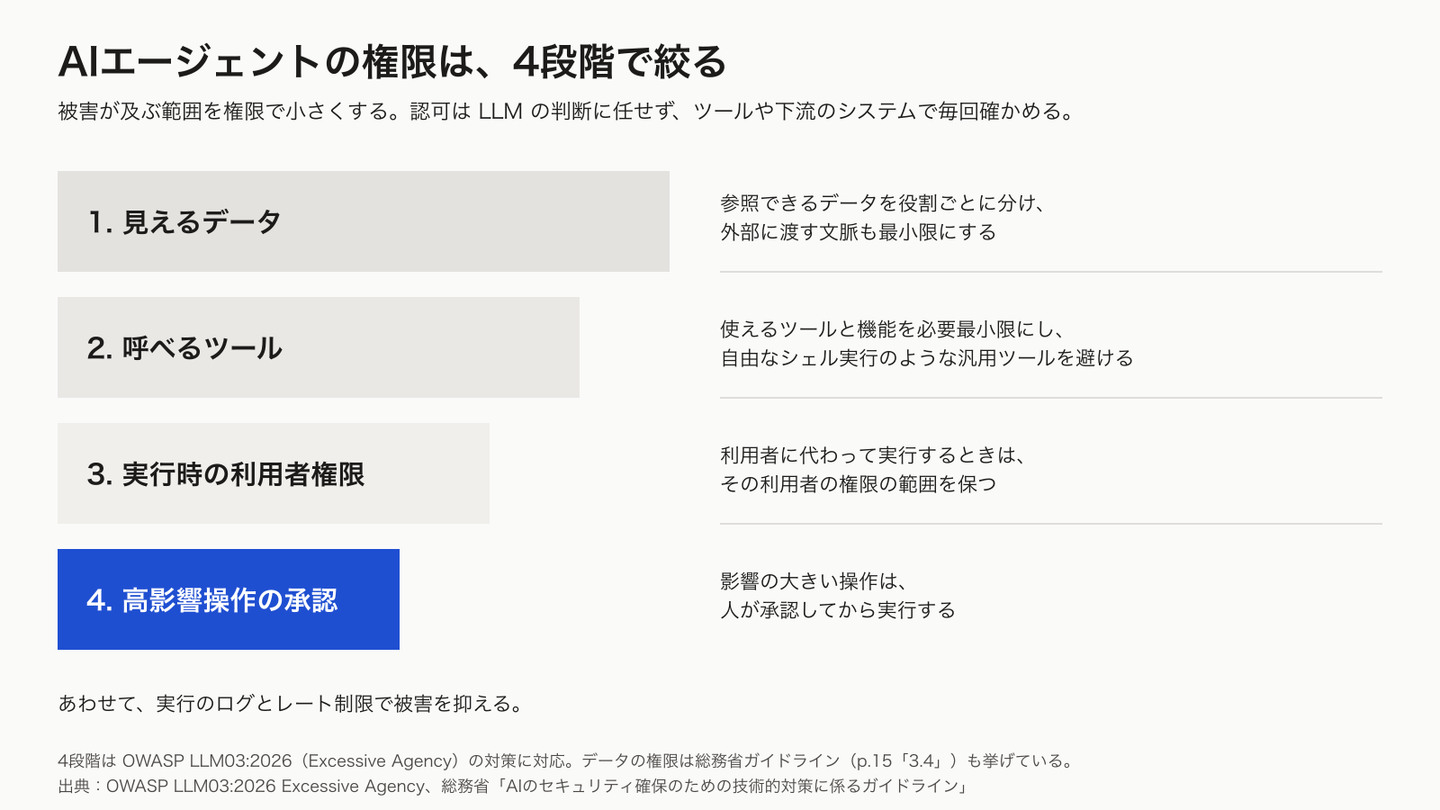
OWASP describes information leakage as occurring in four phases: re-output of content memorized during training; excessive disclosure of conversations and RAG documents at inference time; transcription into derived data and monitoring infrastructure; and inference from observable information. Leakage paths are not limited to the final answer. They also include tool arguments, reasoning traces, search results, logs, telemetry, and embeddings (OWASP LLM02:2026 "Disclosure arises across four phases").
As basic countermeasures, OWASP lists removing personal information at ingestion and minimizing the context passed to external providers (OWASP LLM02:2026 "Tier 1: Foundational"). The MIC guidelines list not writing API keys and similar secrets directly in the system prompt, setting role-based permissions on RAG data and data stores, retaining audit logs, and verifying the reliability of training data (MIC Guidelines p.15 "3.4", p.16 "3.5"). Logs are useful for tracing, but under OWASP's framing the logs themselves can also be a leakage path, so confidentiality management of logs is also necessary.
Whether information entered into an external AI service is used for training, and how long it is retained, varies with the service and contract settings. Check this for each service you use. Countermeasures against "shadow AI," where employees use unapproved AI for work, are covered in detail in our explanation of shadow AI countermeasures.
How Japanese government documents treat AI security
The "AI Guidelines for Business" Version 1.2 (March 31, 2026) from the Ministry of Internal Affairs and Communications (MIC) and the Ministry of Economy, Trade and Industry (METI) covers the AI governance framework, ensuring security, and appropriate use by AI users. The text describes it as soft law with no legal binding force (AI Guidelines for Business, Version 1.2). The MIC guidelines on technical measures mentioned above cover direct and indirect prompt injection, DoS, and more, and present separate measures for developers and providers (MIC Guidelines p.7–16).
In IPA (Information-technology Promotion Agency, Japan)'s "10 Major Security Threats 2026," "cyber risks related to the use of AI" was selected for the first time, ranking 3rd in the organization category. The ranking is based on IPA's selection committee and is not an incident rate (IPA "10 Major Security Threats 2026"). IPA also publishes points of caution for users in its "Security Tips for AI Users" (IPA).
For government agencies, there is Version 2.0 of the "Guidelines for Procurement and Use of Generative AI for the Evolution and Innovation of Public Administration," decided by the Digital Society Promotion Council's executive committee (Digital Agency publication page). It is a document for government agencies and does not impose direct obligations on private companies.
Red teaming and continuous evaluation
The AI Safety Institute Japan (AISI Japan) "Guide to Red Teaming Methodology on AI Safety" Version 1.10 (March 31, 2025) presents methods for developers and providers to evaluate the effectiveness of countermeasures from an attacker's perspective. The revised edition includes an example of implementation on a RAG system and an example report (AISI Japan). The MIC guidelines also note the importance of identifying threats through red teaming and confirming the effectiveness of countermeasures (MIC Guidelines p.12 "3.1"). NIST AI 600-1 also describes red teaming that targets training data output, model extraction, exposure of confidential information, and the like (NIST AI 600-1 MS-2.10-001).
A single assessment does not guarantee safety. The premise is to repeat the cycle of identifying threats, implementing countermeasures, verifying through red teaming, auditing logs and evaluating, and reviewing.
What Japanese companies should check when deciding on adoption
When adopting generative AI or AI agents, we recommend deciding who manages what at each of the following four boundaries.
| Boundary | Main risks | What to check |
|---|---|---|
| User input | Entry of confidential or personal information; use of unapproved AI | Information that may be entered, services that may be used, settings for training use and retention period |
| LLM app boundary | Indirect prompt injection; excessive disclosure from RAG | Validation of input, reference data, and output; role-based permissions for RAG data; confidentiality management of logs |
| Agent execution permissions | Tool misuse; privilege abuse | Range of callable tools; retention of user permissions; human approval of high-impact operations; downstream authorization |
| Continuous evaluation | Unclear whether countermeasures are working | Whether and to what extent red teaming is conducted; audit logs; review cycle |
Also check which boundary each countermeasure covers. For example, a mechanism that manages user input does not control an agent's tool execution. For ways to show an organization's management structure externally, see the difference between C certification and ISO/IEC 42001.
Summary: for generative AI security, separate countermeasures by boundary
Generative AI security is not completed by a single measure. The key is to divide it into four areas (user input, the LLM app boundary, agent execution permissions, and continuous evaluation), design validation, permissions, approval, and logging for each, and keep confirming their effectiveness through red teaming and evaluation.
Elith provides GENFLUX Security, which visualizes AI use within the company and warns on, blocks, or masks confidential and personal information before it is sent; GENFLUX RedTeam, which performs web and API assessments and attack verification against AI; and GENFLUX Evaluation, which evaluates the quality and safety of generative AI, RAG, and agents. These products are responsible for managing user input, verifying attacks, and continuous evaluation, respectively.
For generative AI security measures, see Elith's GENFLUX RedTeam.