

When you consider certification to ISO/IEC 42001, the standard for AI management systems (AIMS), the question is not only how to write policies but how to show an auditor that they are actually in operation. On November 24, 2026, LangChain announced that its AIMS had been certified to ISO/IEC 42001:2023, and it published how it showed agent permission settings, test results, execution records, and its improvement history in the audit (LangChain's article). This article focuses on what LangChain presented as audit evidence.
The scope of the certification and the nature of ISO/IEC 42001
According to LangChain, the certification covers the management system behind every generally available LangSmith feature that runs inference on a model LangChain manages. The Trust Center FAQ adds that the scope includes the internal systems, teams, and information assets supporting those commercial AI offerings (LangChain's article, Trust Center FAQ). It does not mean that all of LangSmith, customers' agents, or individual models were certified.
ISO/IEC 42001 specifies the requirements and provides guidance for establishing, implementing, maintaining, and continually improving an AI management system within an organization (ISO's official page). It is not a standard that guarantees the quality or safety of individual AI products.
The audit process: internal audit and external audit
According to LangChain, certification starts with an internal audit of the management system, after which an accredited external auditor checks that the system operates as documented. The article also mentions annual surveillance audits (LangChain's article). Neither LangChain's article nor the public pages of its Trust Center state the preparation period, the audit dates, the name of the certification body, the certificate number, or the expiry date. The certificate is listed in the Trust Center, but viewing it requires a request (Trust Center Resources).
The evidence presented in the audit
According to LangChain's article, it presented evidence along four questions (LangChain's article).
- What is the agent allowed to do? Using a live agent in LangSmith Fleet, LangChain showed workspace permissions, the setting that fixes at creation whether the agent uses shared credentials or the invoking user's OAuth credentials, and the per-tool
AutoandAsksettings. In a demonstration, the agent was asked to post to Slack through a tool that required approval; when the paused run was rejected with a reason, the agent reported the rejection without retrying. The LangSmith trace captured this run, which served as evidence of the approval requirement and its enforcement. - How do you prove the agent works? The auditor checked the test results for a release and the origin of the test data. LangChain says it kept the dataset and evaluators fixed and linked the origin of the examples, the scoring code, the pull requests and reviews of changes, and the experiment results. It also removed tests that a blank answer could pass and duplicate traces, and investigated any grader that did not give full marks to an answer known to be correct.
- How do you prove what the agent did? Traces made it possible to follow inputs and outputs, tool calls, errors, and pauses and resumes for approval as a single run. The same evaluations used before a release can also run on production traces, and their results and reviewers' corrections are kept with the run. The auditor examined these records.
- How do you improve the agent? LangChain showed a flow in which LangSmith Engine groups recurring failures and investigates their root cause, and the fix pull request and a test on a preview deployment go through the team's normal code review. The auditor followed a change through review and into the codebase. The failing traces become examples in an evaluation dataset, so the failure becomes a regression test for later releases. This does not mean that everything from detection to fix completes automatically.
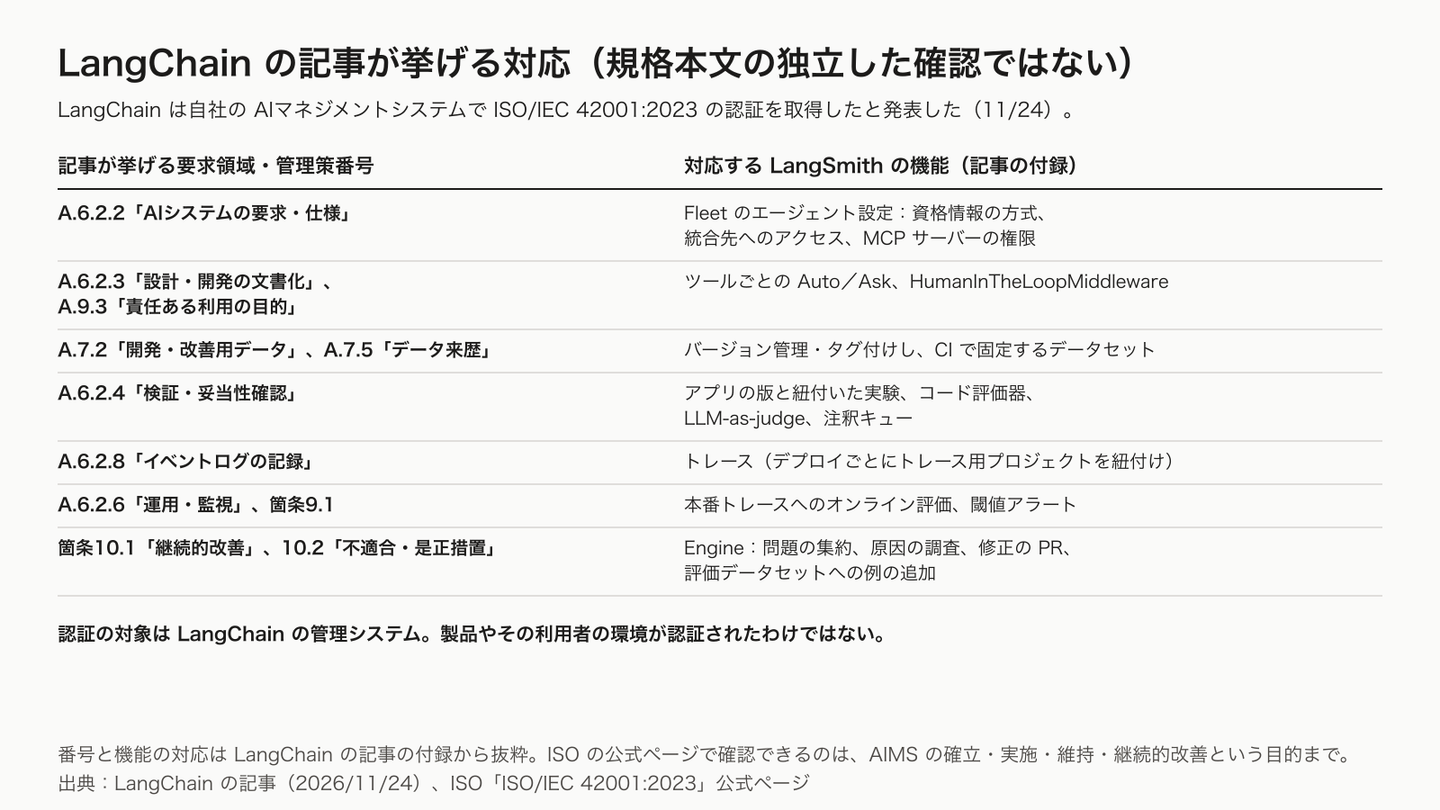
The article's appendix maps these LangSmith capabilities to requirements such as A.6.2.8 "AI system recording of event logs" and Clause 10.1 "Continual improvement." This is how LangChain presents the correspondence; it does not mean that ISO specifies particular features (LangChain's article).
Technical records alone are not enough
LangChain explains that besides traces and evaluations, the standard also requires policies, roles, risk and impact assessments, and documentation for each system (LangChain's article). It says it used an agent it built in-house to help with describing controls, evidence, risk assessments, and the inventory of AI features, but that is an example of how LangChain operates.
What Japanese companies should check before deciding how to respond
If you are considering ISO/IEC 42001 certification, we recommend checking the following.
- Have you decided which organizations, systems, and services the certification will cover?
- For each of "What is the agent allowed to do?", "How do you prove it works?", "What did it do?", and "How do you improve it?", which records can you present as evidence?
- Are documents such as policies, roles, and risk assessments linked to your operational records?
Using a particular tool does not by itself get you certified. The key is to link your policies and operational records along the questions the audit asks.
Elith provides GENFLUX Governance, which centrally manages information about the AI used inside your company and its usage rules, and supports preparing the documents needed for C Certification (AI Governance Core Certification) and AIMS audits. It manages the AI register, rules, risks, approvals, and response records, so you can keep a record of who decided what.
To prepare your AI management system, see Elith's GENFLUX Governance.