
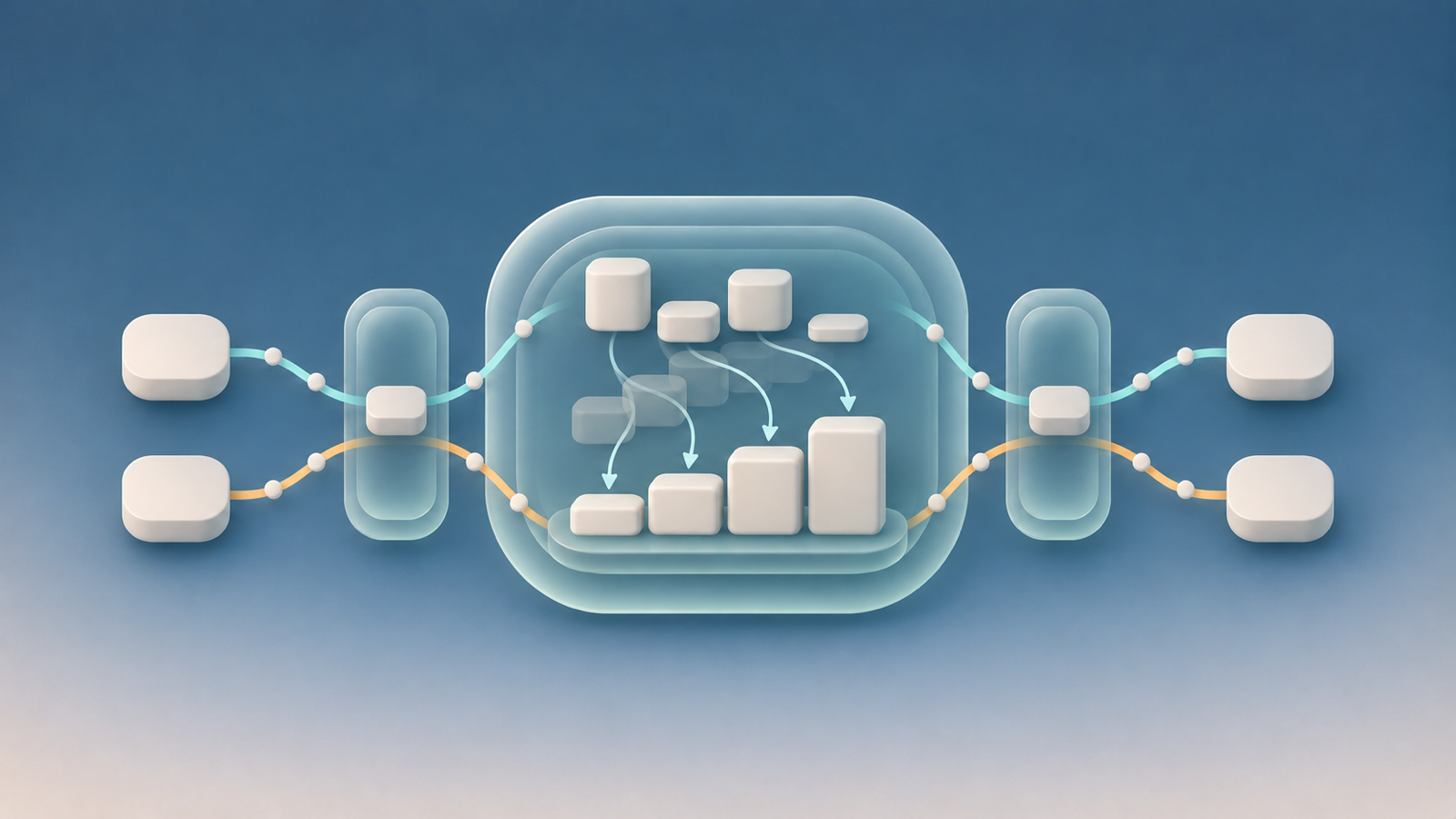
How should you build, train, and evaluate a system in which multiple AI agents cooperate? On November 26, 2026, Hugging Face published a small experiment in which four agents gather information through messages to solve a task, together with how it was trained and evaluated (Hugging Face's article). This article focuses on how the system is built and what to watch for when evaluating it.
Building a multi-agent system: four agents sharing one set of weights
In the experiment, four agents share the weights of a single Qwen3-0.6B. There is one set of model weights, but each agent has its own separate context and a number the others cannot see (Hugging Face's article).
The task assigns each agent one integer from 1 to 99 and asks the team to collect everyone's numbers and sort them in ascending order. Duplicate numbers stay in the list. The team succeeds if any one agent, not all four, submits the complete and correct list. The agents use the tools message(to, text), read_messages(), and check_notifications(), and can send a message to a specific teammate or to everyone (a broadcast).
The training flow: rewarding the team
In the original experiment, each update selects 32 problems and eight teams attempt each problem independently (256 team attempts in total). A pool of 1,024 training problems was generated. On success, the reward is reduced slightly according to the number of tokens the team generated, and a failure receives 0. Rewards are compared within the eight attempts at the same problem, and every agent in a team receives the same advantage. There is no separate reward for the messages themselves (Hugging Face's article, "A team reward and eight attempts at each problem" and "Infrastructure").

Results: read the held-out problems and the training batches separately
On held-out problems not used in training (32 problems for evaluation), the number solved was 1/32 at update 1, 7/32 at update 25, 17/32 at update 50, and 26/32 at update 75 (Hugging Face's article, "Our Results"; the authors' figure data). According to the legend of the authors' figure, this evaluation used one seed (the authors' figure). The number of problems is also small, so it cannot be read as a smooth learning curve.
By contrast, the figure that the success rate went from 6.56% to 82.34% is the mean over training batches in updates 1–5 and updates 71–75, not the success rate on held-out problems. In the same comparison, the tokens generated per team fell from 12,826.9 to 8,026.0, messages rose from 3.48 to 6.28, and broadcasts rose from 2.38 to 5.73. However, the authors say they did not retain held-out token-efficiency measurements for the trained checkpoint.
Evaluation caveats: separate the effect of cooperation from the amount of compute
The authors write that, to distinguish an improvement from multi-agent cooperation from the effect of simply making more attempts, the comparison needs to be made at an equal compute budget (Hugging Face's article, "Did cooperation help, or did we just spend more?"). They then note that in this number-gathering task a single agent cannot know the other numbers, so the task cannot be used for a like-for-like comparison with a single agent (same article, "Our first experiment: four agents ordering numbers"). In other words, this experiment does not show that multiple agents outperform a single agent.
The reproduction steps are a different experiment
The "two H200s, about five hours, roughly $50" at the top of the article is an estimate for the short walkthrough. The original 75 updates used one H200 for training and seven H200s for rollouts (Hugging Face's article, "Infrastructure" and "Practical example"). The published TRL example runs 50 updates and is a different configuration (TRL example). The authors themselves write not to expect an exact replication.
What Japanese companies should check when deciding whether to adopt this
If you are considering multi-agent systems for your work, we recommend checking the following.
- Does the evaluation use problems that were not used in training?
- Do you measure token consumption and the amount of communication along with the success rate?
- Do you compare against a single agent or retries at the same compute budget?
- Have you checked which experiment's conditions the published cost and time figures refer to?
Adding agents alone does not tell you the effect of cooperation. Deciding what to compare against and under what conditions to measure is the starting point for evaluating a multi-agent system.
At Elith, we offer GENFLUX Evaluation, which evaluates chatbots, RAG systems, and AI agents for answer quality, performance, safety, and more, according to your own use case and criteria. It makes the grounds for each evaluation and the points to improve visible, and supports continuous quality improvement from development through operation.
For evaluating AI agents, see Elith's GENFLUX Evaluation.