

Even after a vulnerability is found, it takes time to validate the official patch and roll it out to production. Shirudo, announced by OpenAI and Cisco on November 23, is an open-source effort to deliver temporary protection to running Linux systems and applications during that window. It is designed so that people validate and approve the protection code AI generates before it is applied, which makes it a concrete case for thinking through what it takes to bring AI into security operations. This article draws on both companies' announcements and the published documentation to explain how Shirudo works and what to keep in mind when reading about it.
Shirudo at a glance
OpenAI describes Shirudo as an open-source runtime that protects Linux systems while patches are being rolled out, and Cisco describes it as a joint open-source project (OpenAI's announcement, Cisco's announcement). OpenAI says it contributes its AI, security, and infrastructure research, and Cisco its infrastructure and security expertise. According to a technical article from Isovalent, a Cisco company, Shirudo grew out of rebuilding Tetragon, the eBPF-based tool Isovalent developed, for agents (Isovalent's technical article).
The project itself is licensed under BSD 2-Clause, and its BPF programs are dual-licensed under BSD/GPL. Some files that originate from third parties carry other compatible licenses (public repository).
Four elements of how AI-generated protection is applied
Shirudo is built on eBPF. As OpenAI explains it, small eBPF programs run at specific points inside the operating system, which makes it possible to observe suspicious activity on a running system and to block targeted, vulnerable code paths. The design has teams monitor how a proposed protection (a shield) would affect normal application behavior before they decide whether to apply it (OpenAI's announcement).
OpenAI lists the following four design elements (OpenAI's announcement).
- Live protection that requires no restart
- Agents that investigate, write, and validate protection code, with people controlling deployment
- Cryptographic signature verification, and load controls such as the Linux eBPF verifier
- A verifiable record, using a TPM, of protections being loaded and removed
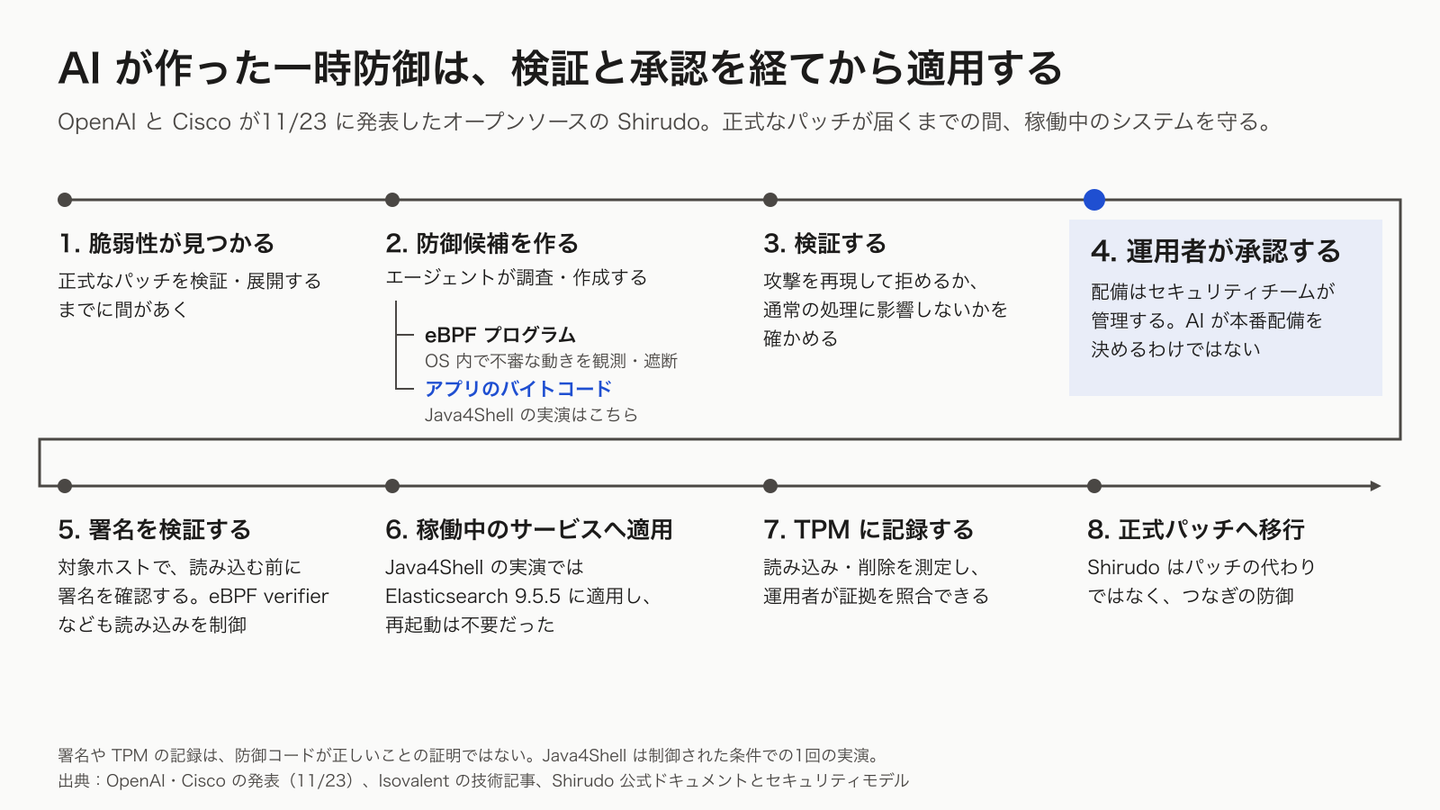
According to the official documentation, an operator distributes a signed package to the target hosts, and each host verifies the signature before loading it. State changes such as loads and removals are measured by the TPM, and operators can check them against TPM-signed evidence (official documentation, official security model).
AI does not decide what gets deployed. OpenAI explains that security teams control deployment and operators approve it. Isovalent writes that the degree of automation can be set by design (OpenAI's announcement, Isovalent's technical article).
The Java4Shell demonstration
The announcements describe a demonstration using the Java4Shell vulnerability. With Codex on the control side, the team generated a protection and applied it to a running Elasticsearch 9.5.5. The protection was Java bytecode that added an input check to Java's Base64 decoder. It rejected the input used in the attack, and the demonstrated attack did not succeed. OpenAI notes that no restart was needed in this test (OpenAI's announcement, Isovalent's technical article).
The protection used here was not an eBPF program. Isovalent explains it as an example of modifying application-side bytecode for a kind of vulnerability that eBPF is not suited to (Isovalent's technical article).
Points to keep in mind about vulnerability response with generative AI
This demonstration was a single test in a controlled environment. The result does not show that Shirudo can defend against every vulnerability without a restart, or that it causes no false positives or service outages. Shirudo is a temporary protection until the official patch arrives, not a replacement for the patch.
Signatures and TPM records, too, do not show that the protection code is correct for the business, or that it cannot be compromised in any environment. The official security model states explicitly that these properties depend on assumptions such as a trusted kernel, Secure Boot, TPM 2.0, and protection of the signing keys (official security model).
OpenAI and Cisco say they will hold a technical webinar on December 15 (OpenAI's announcement, Cisco's announcement). At the time of writing, we have not been able to confirm the start time or how to register.
What Japanese companies should check when deciding whether to adopt it
There are four points to check when considering adoption. The first is who approves the deployment of a protection. Shirudo assumes operator approval, so the people who approve and the criteria they use need to be decided in advance. The second is whether your own environment can meet the assumptions listed in the official security model. The third is the means of protection that fits the vulnerability you want to defend against. As the Java4Shell demonstration shows, there are cases where the attack was blocked with application bytecode rather than eBPF. The fourth is the procedure for moving from the temporary protection to the official patch.
We recommend designing the whole sequence, from validating and approving a generated protection to moving to the official patch, as an operational procedure.
Elith offers GENFLUX RedTeam, which assumes attacks on web services and AI and tests for weaknesses and their impact. It covers vulnerability assessment of web applications and APIs and attack testing of AI and agents. Engineers review the results and set out the priority of countermeasures and the direction for improvement.
For security measures for generative AI, see Elith's GENFLUX RedTeam.
Primary sources
- OpenAI: Shirudo announcement (November 23): https://openai.com/index/introducing-shirudo/
- Cisco Newsroom: Shirudo announcement (November 23): https://newsroom.cisco.com/c/r/newsroom/en/us/a/y2026/m11/cisco-and-openai-launch-shirudo-a-new-project-to-safeguard-agentic-ai.html
- Isovalent: Shirudo technical article (November 23): https://isovalent.com/blog/post/cisco-openai-shirudo/
- Shirudo public repository: https://github.com/shirudo-dev/shirudo
- Shirudo official security model: https://docs.shirudo.dev/security/security-model.html
- Shirudo official documentation: https://docs.shirudo.dev/
By the Elith Editorial Team