
On November 25, 2026, the password manager 1Password disclosed that an attacker had gained access to its backend systems and copied account information belonging to some of its users (1Password's announcement). The company says that vault contents and the keys that protect them were not affected. What follows is based on the company's explanation as of this writing.
The intrusion as disclosed by 1Password
According to 1Password, on November 19, 2026 the company began investigating indications of unauthorized access to an employee's corporate GitHub account. That is the date the investigation began. The company has not disclosed when the intrusion started or how the account was first compromised (1Password's announcement, "What happened").
The attacker used this corporate GitHub account to view source code and to push malicious code to backend services. The company explains that customers' administrative data was downloaded from there. The attacker also copied source code from private repositories and gained access to the CI/CD system (1Password's announcement, "What happened" and "What information was affected").
What leaked: some account information
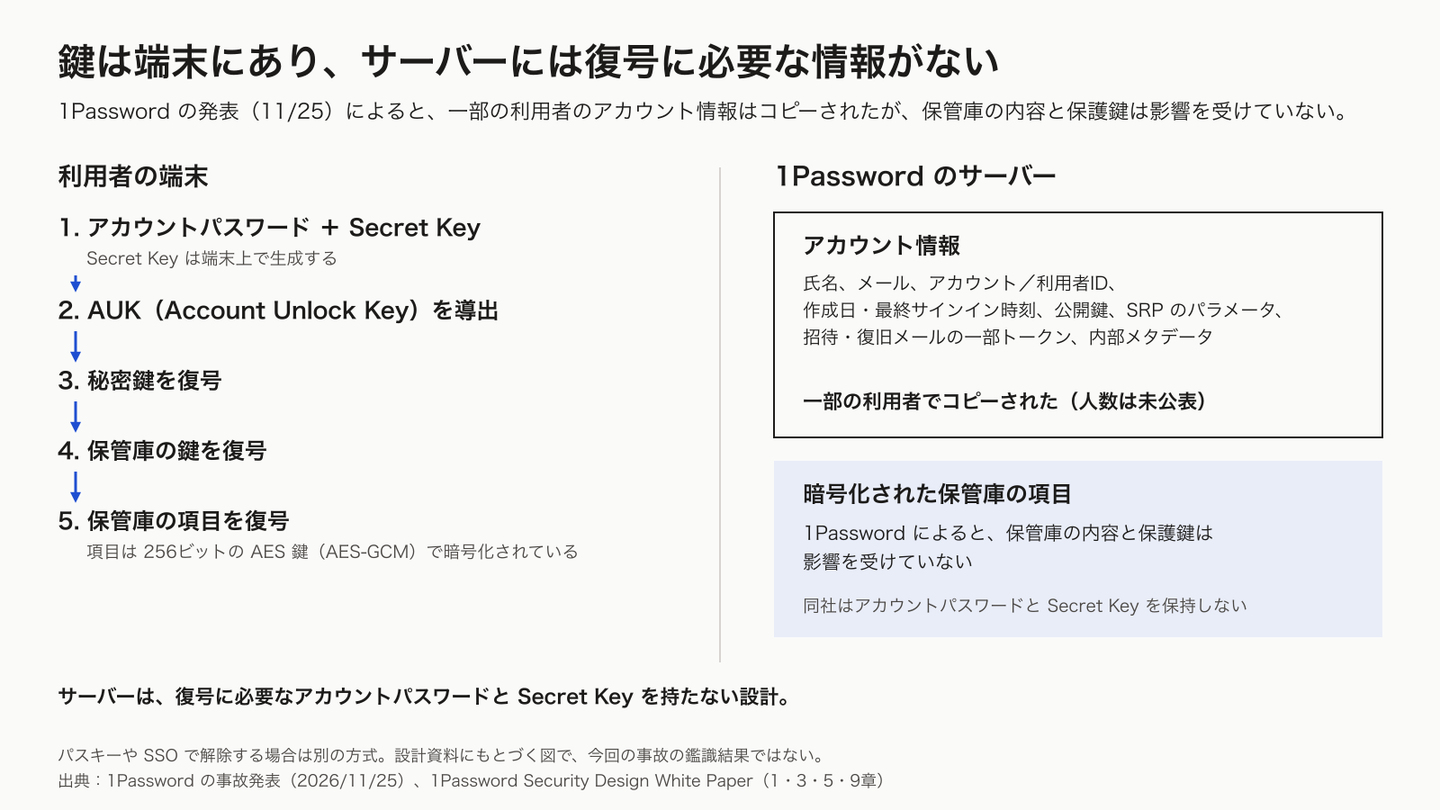
According to 1Password, the following information was copied for a subset of users. The number of people affected has not been disclosed (1Password's announcement, "What information was affected").
- Names and email addresses
- Account IDs and user IDs
- Account creation dates and last sign-in times
- Public keys and SRP parameters
- Tokens contained in some of the emailed links for invitations, provisioning, and account recovery
- Internal metadata
Of these, the tokens contained in emailed links concern a "small number" of users, and the company says it has notified them individually. According to the company, a token alone cannot be used to access an account: it has to be combined with an SSO sign-in or with a code sent to the registered email address. As a precaution, this code was changed from six numeric digits to ten alphanumeric characters. The company says it has found no internal evidence of account takeover or compromise using the exposed provisioning tokens (1Password's announcement, "What we've done").
How the vaults stayed protected
According to 1Password, the attacker could not access vault contents, and vault contents and the keys that protect them were not affected. The company explains that it does not hold users' account passwords or Secret Keys (1Password's announcement, "The short version" and "What was not affected").
According to the company's security design documentation, when an account is unlocked with an account password and Secret Key, the Account Unlock Key (AUK) is derived from both the Secret Key, which is generated on the device, and the account password. The AUK decrypts the private key, the private key decrypts the vault key, and the vault key decrypts each item. Items are encrypted with a 256-bit AES key generated on the device. Key generation and encryption take place on the device, and the server does not have the account password and Secret Key needed for decryption (Security Design White Paper, "Key security features", "Account password and Secret Key", "How vault items are secured").
This documentation describes the design. It is not the findings of the incident investigation. Also, users who unlock with a passkey or SSO use a different mechanism from the account password and Secret Key method ("Unlock with a passkey or single sign-on").
1Password's response
1Password says it disabled the affected GitHub account, revoked the stolen token, and rotated or revoked internal credentials that may have been exposed. It does not say when this was completed. The company states that users do not need to update anything in their 1Password accounts (1Password's announcement, "The short version" and "What we've done").
What users should do now: watch out for phishing
1Password recommends being cautious about unexpected emails, text messages, and phone calls that mention the company. Be especially careful with invitations and recovery messages that you did not initiate. The company also states explicitly that it will never contact you to ask for your account password or Secret Key (1Password's announcement, "What you can do").
A separate incident in the same period: the intrusion into Defang's build system
In the same period, on November 24, Defang also disclosed an incident. According to the company, on November 12 an attacker used its GitHub App for development to run code in its production CI, and copied credentials and its main database (Defang's announcement). This is a separate incident from the one at 1Password, and there is no primary source showing that the attacker or the cause is the same.
What Japanese companies should check when deciding how to respond
Companies that use 1Password internally should check the following points.
- Whether employees have been told to watch out for unexpected invitation and recovery messages.
- Whether you know if your users unlock with an account password and Secret Key, or with a passkey or SSO.
- Whether someone has been assigned to follow further updates on points that have not been disclosed, such as the number of people affected.
The vault, which is encrypted on the device, and the account information handled on the server are protected in different ways. Reading the two separately is the starting point for choosing the response you need.
At Elith, we will continue to read disclosures like this one on the basis of primary sources and report on them.