
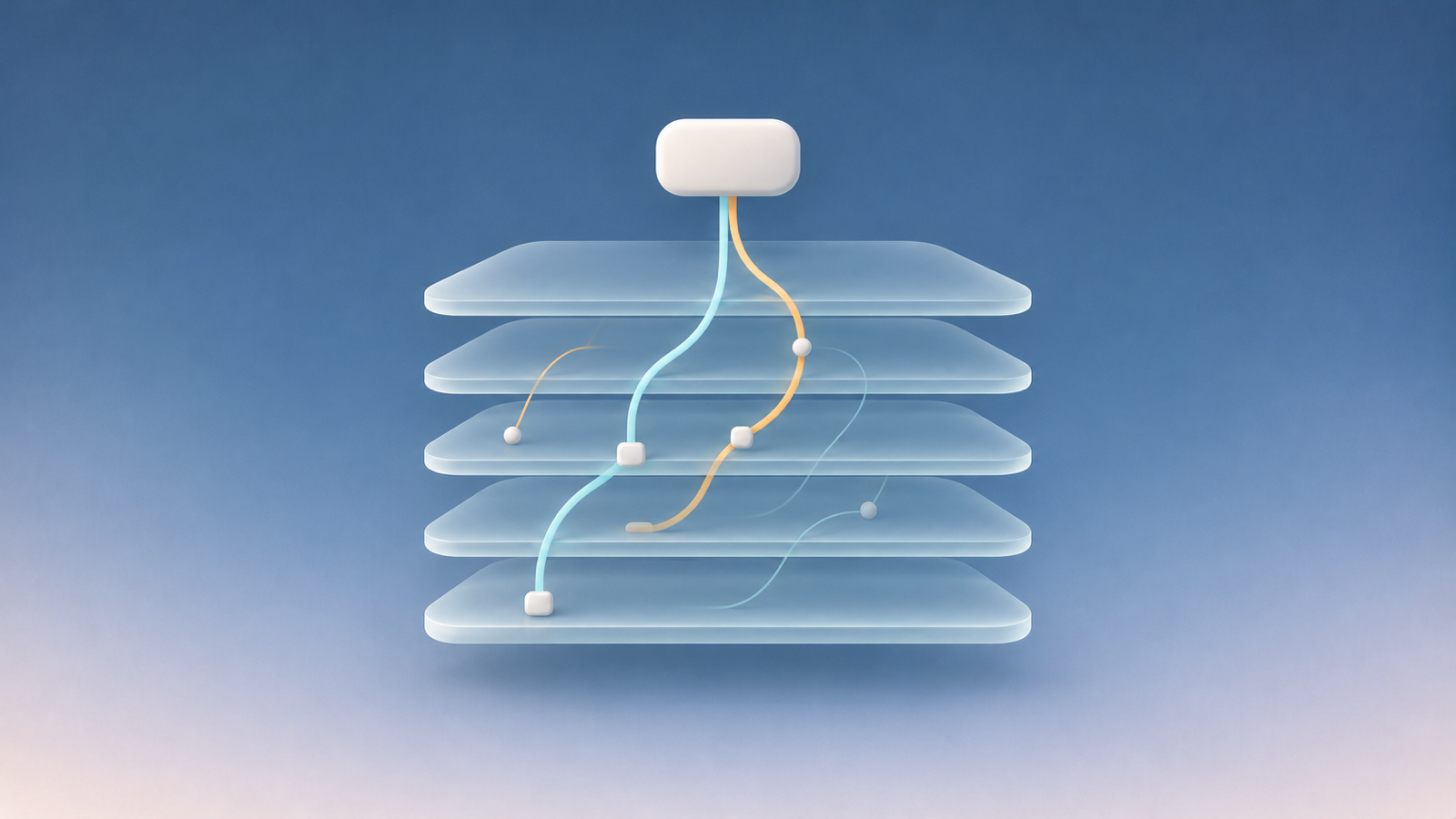
Transformers train deep networks with residual connections, which add each layer's output to the preceding state. On November 23, 2026, Google Research introduced "DeepCrossAttention (DCA)" on its blog, an approach that replaces this residual connection with a mechanism that selects and combines representations from earlier layers depending on the input (Google Research blog). According to the blog, the underlying paper was presented at ICML 2025, so this is not newly published research. This article sorts out how the mechanism works and under what conditions the numbers should be read.
How DCA differs from a standard residual connection
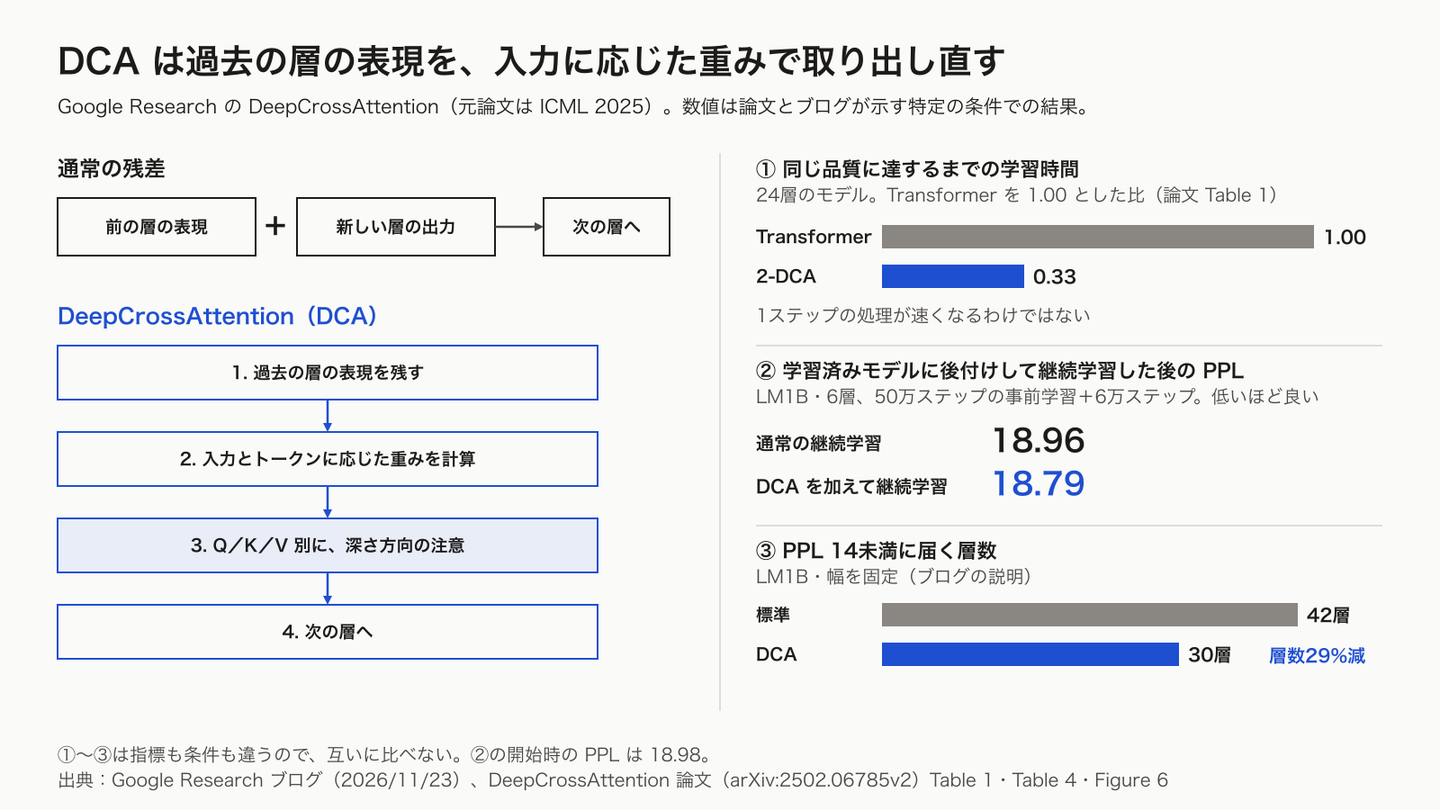
A standard residual connection adds the new layer's output directly to the previous layer's representation. DCA keeps the representations of earlier layers, mixes them with learnable weights that depend on the input and the token, and integrates them through depth-wise cross-attention. The weight generators for Q, K, and V are separate. Its defining feature is that the route changes per token, rather than being an addition with fixed weights (paper, Section 3).
According to the blog, the additional parameters amount to less than 0.2% of the total model size. In the paper's 6-layer example, the standard transformer has 49.65M parameters and DCA has 49.73M, an increase of about 0.16% (paper, Table 5). This is not a figure guaranteed uniformly at every scale. The paper also notes that because the stack of retained layer outputs grows linearly with depth, it could lead to significant memory and computational overhead for deep models, and it presents a variant that explicitly uses only the first and the last k layer outputs (paper, Section 3.1).
Read the numbers together with their conditions
Training time to reach the same quality
The blog's "up to three times" refers to the training time needed to reach the same quality, not to inference speed. In the paper's comparison on a 24-layer model, taking the training time for the standard transformer to reach its final PPL of 15.14 as 1.00, 1-DCA and 2-DCA took 0.33 (about one third). On the other hand, the standard transformer processes 8.14 batches per second against 5.39 for 2-DCA, so an individual step does not get faster (paper, Table 1).
The blog also says "up to five times fewer training steps," but we could not identify the conditions in the paper's tables that correspond to this figure. The three-times figure is about time and the five-times figure is about steps, so the metrics differ as well.
The same quality with fewer layers
In the comparison on LM1B with varying depth, the 30-layer DCA model obtained a better PPL than the 42-layer standard transformer. That is about 29% fewer layers (paper, Figure 6). The blog describes this result by saying that to reach a PPL below 14, a standard transformer with fixed width required 42 layers, whereas DCA achieved a lower PPL with 30 layers. The blog also contains the summary that DCA achieves "comparable or improved learning, while reducing the number of parameters needed by up to 30-40%," but since the conditions of the individual experiments behind it are unclear, it should be read separately from the 42-layer versus 30-layer example.
Retrofitting a pre-trained model
Because DCA can be initialized to behave identically to the original model, it can be added to a pre-trained model and training can continue. In the paper, a 6-layer transformer on LM1B was trained for 500k steps and then for a further 60k steps. The PPL at the start was 18.98; it was 18.96 with ordinary continued training and 18.79 with DCA added (paper, Table 4). DCA's improvement of 0.19 is the difference from the start, and the final difference from ordinary continued training is 0.17.
Relationship to related methods
The blog also introduces "Attention Residuals," which it says was developed by Moonshot AI, and "Hyper-Connections" as related methods (Attention Residuals, Hyper-Connections). Both were proposed in papers separate from DCA. In the paper's 6-layer comparison, PPL was 18.98 for the standard residual connection, 18.65 for Hyper-Connections, and 18.06 for DCA (paper, Table 5).
Google Research says that Thinking Machines' Inkling 2 adopted DCA's Q/K/V split. The Inkling 2 Small model card that Thinking Machines publishes, however, contains no description of its residual connection design as of our check on November 29, 2026 (model card).
What to check when reviewing transformer training efficiency
Companies that train or continue training their own models would do well to check the following points.
- Are you distinguishing which metric a reported improvement refers to: training time, number of steps, or number of layers?
- How close are the paper's conditions (LM1B, depth, width) to the scale and use of your own models?
- Even if training time goes down, have you allowed for the heavier per-step processing and memory load?
The numbers in this paper alone do not tell you whether the same improvement will appear in large commercial models or how inference latency will be affected. Trying it on a small scale under your own conditions looks like the starting point.
Elith builds AI products for enterprises and conducts advanced research on a foundation of AI safety and security. We share trends in AI safety and security and insights from research and practice in Elith AI Signal. We will keep reading research like this against primary sources and reporting on it for those working on model development.