
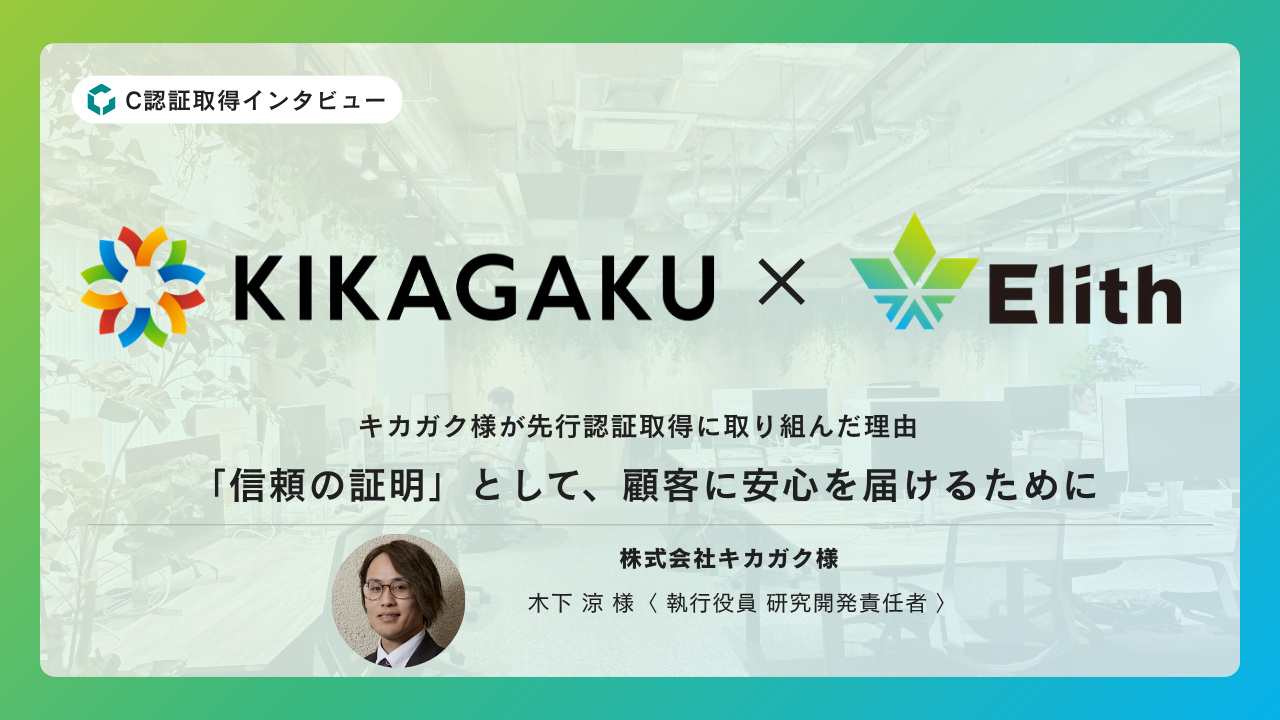
As generative AI adoption spreads, companies are being asked to establish rules for using AI safely and appropriately, and to build an ongoing governance structure.
Against this backdrop, Kikagaku, Inc. worked to obtain 'C Certification (AI Governance Core Certification),' a third-party AI governance certification. While the company had already made progress developing AI usage rules and a management structure internally, as a provider of AI governance support, it felt the need to put its own AI governance back in order.
This time, we spoke with Kinoshita, who led the effort to obtain C Certification, about the background to pursuing it, the internal structure, what mattered most during the process, their experience with Elith's support, and their outlook for the future.
Background to pursuing C Certification
What was the occasion or the goal that led you to pursue C Certification?
A big part of it was learning about the certification program through an information session hosted by JDLA.
Our company has built its business primarily around education in AI and other advanced technologies, and from there, we've increasingly taken on cases supporting companies in building AI usage environments and governance structures.
Amid that, we felt a credibility gap in not having any certification or objective standard for our own AI governance. As a company whose position is to convey the importance of AI governance to clients and support them in it, we felt we needed to show that we were doing the right thing ourselves, which is why we decided to pursue certification.
Before pursuing C Certification, were there any challenges or concerns you anticipated as potential hurdles?
Honestly, we didn't have many major concerns, mainly because our CTO and CFO had already been leading the development of rules and a management structure for AI use internally.
That said, figuring out just how high a standard the certification required, and how far we needed to go in organizing things, was hard to judge on our own. Moving forward without knowing the required standards or certification criteria would have been quite difficult.
In that respect, having Elith's support made clear exactly what we needed to prepare for certification, which let us move forward with confidence.

Process and structure leading up to certification
What internal structure and division of roles did you use to pursue certification?
This time, we put together a team with an emphasis on moving quickly.
I oversaw progress in something like an overall project manager role, and we built the team only with people who could act on their own discretion—the head of our legal department, and members with authority over and management of our internal AI systems, among others.
Instead of drafting documents and then routing them repeatedly for confirmation from other members, we set up a structure where decisions could be made within the project itself, which let us move very quickly. Even confirmations with management were handled through Slack, getting decisions back within a short amount of time.
The head of legal handled legal matters, while members who actually held the relevant authority handled AI permissions and management, and I took on the role of driving the whole thing forward from the top.
What points did you particularly focus on, or find challenging, as you worked through the process?
One thing we were particular about was making sure our efforts weren't just for the sake of obtaining C Certification.
For example, when we put together our AI regulations, we didn't just stop at drafting them—the head of our corporate division communicated them company-wide the same day. We made a point of announcing, 'these are newly established internal rules, so please make sure to review them,' with the aim of making them something that would actually function in day-to-day operations, not just something for the sake of certification.
One challenge was that, with everyone's regular work on top of things, it was difficult to formally allocate significant resources specifically for certification. Even so, members of our team cooperated voluntarily, which let us keep up the pace.
What changes did Elith's support bring in terms of progress and decision-making?
Frankly, all of it was a help.
Since C Certification is a new program, we were completely unfamiliar with it going in. Having Elith share what we needed to prepare and how far to take it, along with real, practical judgment calls on the certification criteria, made a huge difference.
It also wasn't just advice—Elith actually rolled up their sleeves and helped with the work itself, which we were very grateful for. I think the speed at which we obtained certification would have been quite different without Elith's support.

Effects expected from obtaining certification
What was your honest reaction when you learned certification had been granted?
More than anything, I felt relieved. That said, getting certified isn't the end—what matters is how we use it from here. How we connect having obtained C Certification to our business and our messaging is up to us. Of course I'm happy about it, but I also feel like this is another starting point.
What effects do you expect from C Certification, both externally and internally?
Externally, I think we can use it as proof of trust when we give lectures or provide content on AI governance. Since our position is to teach people and communicate to companies about AI governance, holding C Certification ourselves is, I believe, important for strengthening the credibility of what we communicate.
Internally as well, this certification process turned out to be a good opportunity. We had already set rules for AI use before, but the process also made us realize that some of the rules we'd set a few years earlier had become a formality in practice.
For example, we found cases where people were using AI tools outside the internally approved list, which let us communicate the rule company-wide once again: 'use only the tools on the list,' and 'anything else requires an application and review before use.'
What we want to convey to clients, our company, and the market
How would you like to connect your AI governance efforts to future business growth?
I believe AI governance will become a standard expectation going forward. Given that, demand for AI governance education and support in building governance structures at other companies should keep growing, so we want to accelerate the AI governance-related business we're already working on.
We'd also like to contribute to spreading the C Certification program itself, with an eye toward becoming a certified consulting firm. As C Certification becomes more widespread, I believe it will help create an environment where companies can use AI with greater peace of mind.
Through this certification, is there a message you'd like to convey to clients, your company, and the market?
Putting together AI regulations and a list of the AI tools in use isn't just for certification—I think it's something that will become standard practice going forward. AI governance isn't something special; it should become a theme that every company using AI needs to face. That's exactly why using certification as an opportunity to review your own rules and operations has real significance.
As a company that teaches AI governance ourselves, we'd also like to translate the lessons and key points we gained from obtaining C Certification into our future content and support.
Do you have any advice for companies now considering pursuing the same certification?
First, I think it's important to approach putting together AI regulations and an AI inventory as something you'll need regardless of certification. Rather than treating C Certification as something special, it may help to see it as an opportunity to build the kind of structure that will simply be standard for companies going forward.
The other thing is to move quickly. Efforts like this can be put off indefinitely if you let them drag on. That's why I think it's important to build a team of members who can make decisions and act on their own discretion.
A message from Elith to Kikagaku, Inc.
Thank you very much for taking part in this valuable interview.
As a company that supports and communicates AI governance, the way Kikagaku approached C Certification—using it to demonstrate your own efforts against an objective standard—felt truly characteristic of a company that values 'proof of trust.' We also found it a deeply meaningful process that you didn't stop at paperwork, but carried certification through to company-wide communication and a review of actual operations.
Because everyone involved moved with such speed, you were able to steadily reach the review stage despite this being a new program. We at Elith were also glad to walk alongside you, helping organize the standards and preparation required.
We believe the lessons and practices Kikagaku gained through this process will, through your future AI governance education and support, help many companies use AI with greater peace of mind. We at Elith will continue to walk alongside Kikagaku's efforts, and hope to contribute to building a society where AI can be used safely and proactively.
![[Free webinar, held 9/17] Building a risk management structure with 'C Certification,' the third-party AI governance certification (connpass registration page)](https://cdn.sanity.io/images/asurrzft/production/f78c72f328d9e23831183fa1ec86e1a53c0d8596-1280x670.png)