

Wi-Fi is everywhere: in homes, offices and commercial facilities. Its radio signals carry subtle changes caused by people's movements, such as standing, walking or sitting down. Wi-Fi sensing reads those changes to recognize what people are doing without cameras or wearable devices.
ai6 and Elith Inc. are developing a HAR (Human Activity Recognition) engine that recognizes people's continuous activities from time-series data such as Wi-Fi CSI (Channel State Information). Starting with elderly care, ai6 and Elith are jointly collecting data and developing and improving the AI models. Through trials at care facilities, they are moving the technology toward practical use.
What does the technology need to recognize to be useful in care settings? How should it balance missed detections against false alarms? We asked about the background of the collaboration and the challenges the teams are working through.
Participants: Marumo and Kadotani (ai6); Shimogauchi and Kojima (Elith)
*Questions and answers have been edited for wording and structure without changing the substance of the interview.
Putting existing Wi-Fi to work for watching over people
Shimogauchi: "What concerns led ai6 to work on Wi-Fi sensing?"
Marumo: "At first, we were simply interested in the technology itself. But when I was looking after my own parents, I realized that just knowing they were active at home gave me peace of mind, even from far away. As society ages and care workers become scarcer, we came to see spreading Wi-Fi sensing as new social infrastructure as our mission."
ai6 is focused on the potential of using the Wi-Fi that is already in place. If it can cut the time it takes to develop, sell and install dedicated devices, it believes monitoring can reach the people who need it sooner.
When daily activity levels and changes in someone's routine are visible, family members and caregivers can more easily notice that something is wrong and follow up with a conversation or care. Catching changes before someone needs care is also part of the monitoring ai6 is aiming for.
Reading daily activities from radio signals
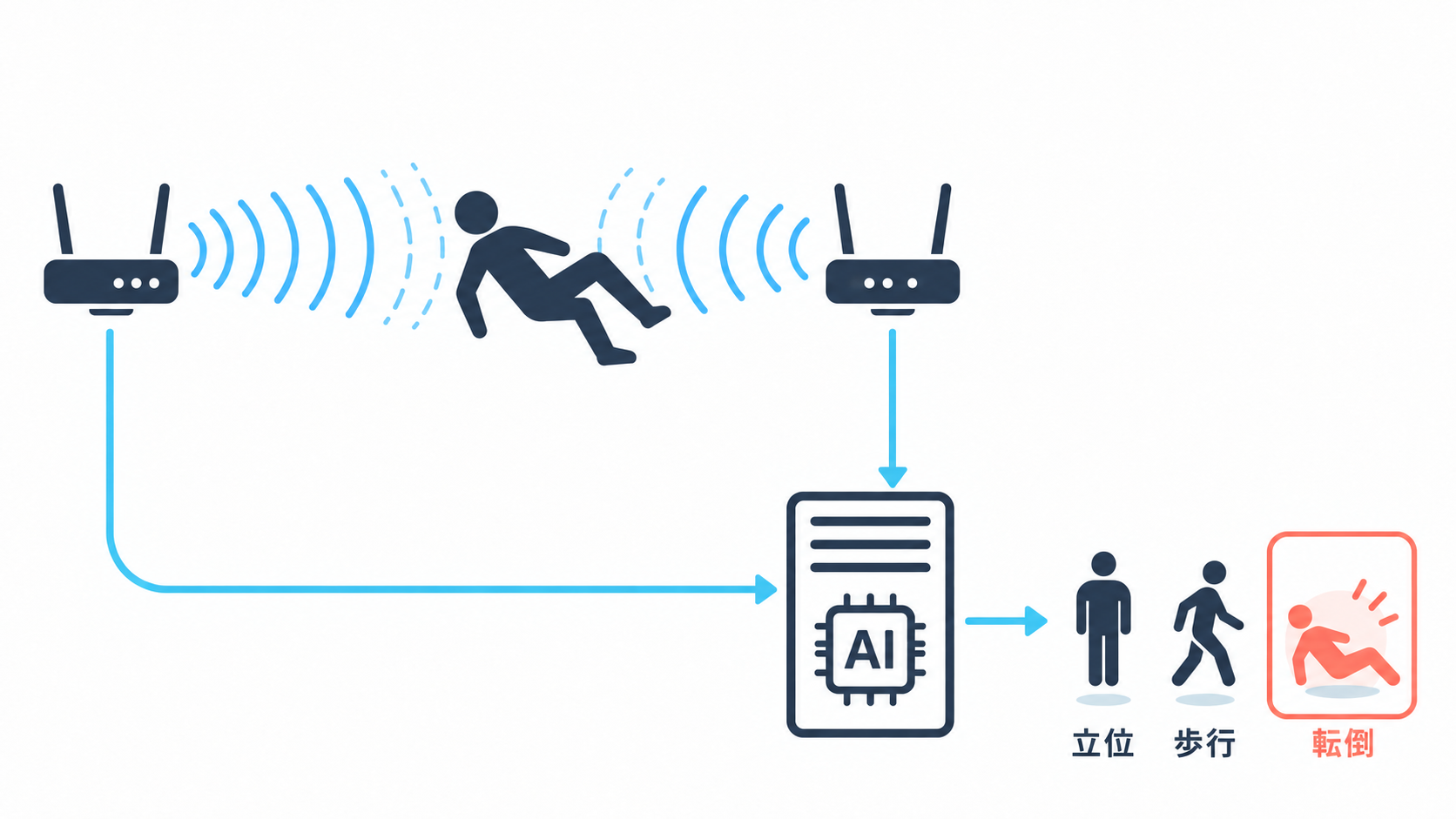
Unlike an image, the data captured by Wi-Fi sensing does not show a person's figure. A model has to learn how the radio signal, which changes with people's movements and the room environment, corresponds to what they are actually doing.
The teams are now building a prototype HAR engine for demos and future integration into applications, while reviewing existing fall-detection algorithms and the data collection setup. The two companies work together on everything from collecting data close to real-world conditions to designing the models and evaluation methods and validating them.
Shimogauchi: "Why did you choose Elith as your development partner?"
Marumo: "When we decided to develop our own high-accuracy activity analysis, we wanted to work with a company that had strong technical skills and was eager to take on new fields. We asked a university professor for an introduction, evaluated Elith's proposal against our requirements, and decided to move forward with joint development with Elith."
Kadotani: "Even with the constraints we face in collecting data, I didn't expect the model's accuracy to improve this much. We are now at the stage of making it more general, but we feel good about the current model."
In development, the teams are working out not only which activities to recognize and in how much detail, but also how to communicate the results to people on site. The two companies are building a system that improves the model across the whole loop, from recognizing activities to sending notifications and receiving feedback from the field.
From single activities to the flow of daily life
Shimogauchi: "What would tell you the technology is ready for use in care settings?"
Marumo: "In real life, activities change one after another: standing up, walking, sitting down, lying down, falling asleep. I think one benchmark for practical use is recognizing that whole flow with high, balanced accuracy. High accuracy on just one activity isn't enough for a service."
At the time of the interview, development was moving from recognizing single activities to recognizing everyday scenes in which several activities follow one another. While capturing the moments when one activity turns into another, the question is which changes to flag as important signs. The teams will confirm recognition performance and notification criteria through trials at care facilities.
Tuning the balance between missed detections and false alarms to each site
Shimogauchi: "If you send more notifications to reduce missed detections, false alarms increase, and people may stop paying attention to the notifications at all. How do you think about the balance between the two?"
Marumo: "Some facilities want to catch warning signs even at the cost of some false alarms, to prevent accidents. Others already have many devices sounding alerts and want fewer false alarms. The sensitivity people want differs not only by facility but also by the staff member on the night shift."
Kadotani: "The metrics that measure how mature a technology is don't necessarily translate into its value once it is deployed in society. We need to confirm what a service really needs and adjust to it. Making sure there aren't so many notifications that people stop looking at them is part of that."
With these differences in mind, the two companies will evaluate the system together with how each facility operates and how staff respond to notifications. Beyond recognition accuracy, whether staff who received a notification could follow up with a check or with care will also be a measure of practicality.
Feeding what care facilities confirm back into development
The two companies plan to jointly collect data and validate real-world operation at care facilities. Because staff can check the situation whenever a notification is sent, detection results can be compared with what actually happened.
Marumo: "A big reason to start with care facilities is that we can validate there. When we notify staff that something is wrong in a room, they can check on site right away and tell us whether it was a false alarm. We want to use that feedback to improve accuracy and reduce false alarms before expanding to ordinary homes."
Using the collected radio data and the results confirmed on site, the teams will investigate in which everyday scenes misrecognition or missed detections occur, and revise the model and the way notifications are issued. The two companies will also consider how much detail to ask of staff when they check a situation, and how to reflect the results in the next round of development.
From care to home security and energy saving
Shimogauchi: "What role does ai6 want to play going forward?"
Marumo: "We are aiming for an activity analysis engine that many different applications can use. Beyond care, we would provide information through an API for home security, energy saving and more, and leave the UI to each service provider. In the future, we'd like to become something like an LLM for indoor human activity."
ai6 envisions providing its activity analysis engine to businesses in many fields so that they can build services suited to their own users. It aims to make the engine usable through APIs and no-code tools, even without expertise in radio signals.
In care, the first use case, the teams will verify how well activities in daily life can be recognized and which notifications are actually helpful. ai6 intends to apply what it learns there to home security, energy saving and other fields.
Because the system handles information about people's daily lives, privacy, data handling and regulation also need to be considered. Through trials in care settings, the two companies will also pin down the practical issues of using it.
ai6's ties to care sites, its data and its knowledge of the care field feed into Elith's model development and evaluation. Confirming recognition performance and the usefulness of notifications at care facilities first is the next step toward expanding to ordinary homes and other services.