
Shadow AI is employees using, for work, AI services that their organization has not permitted or does not manage. This article lays out the risks that arise from shadow AI and publicly disclosed cases, how national guidelines treat it, and the types of countermeasure, and explains how to connect them to an AI governance structure that includes usage rules, management of permitted tools, and review.
Definition of shadow AI
IPA (Information-technology Promotion Agency, Japan) describes shadow AI as employees ending up using unapproved AI for work (IPA, Generative AI security for security practitioners). A typical case is entering business information into a generative AI service the company has no contract for, or into an AI service used with a personal account.
The problem is not the use of AI itself. It is that the company is unaware of the use and cannot confirm which information was sent to which service. Without that understanding, it can decide neither the criteria for information that may be entered nor the response when something is sent by mistake.
Risks and cases that arise from shadow AI
A publicly disclosed case: mistaken upload to an external AI service
On September 3, 2026, RIZAP Inc. announced that, while aggregating data, an employee had mistakenly uploaded part of the data on people receiving specific health guidance to an external generative AI service the employee used personally. The data included personal information such as names and health insurance card symbols and numbers, and special care-required personal information such as the type of support and information on medical conditions (RIZAP Inc.'s announcement, section 1, overview of the incident).
The company says it reported the matter to the Personal Information Protection Commission, deleted the chat history, and changed the setting to stop the data being used for training. As measures to prevent recurrence, it lists reminding employees again that using unapproved AI for work is prohibited, training, reviewing access rights and the usage environment, and considering the introduction of an AIMS (same announcement, section 2, current status of the response, and section 3, future response and measures to prevent recurrence). The company also explains that there is no possibility of viewing or use for training by third parties other than the operator of the AI service, while saying it is still confirming whether the operator's officers, employees, and others could have viewed the data.
What this case shows is that, even without malicious intent, business data can be sent to an external AI service in the course of everyday work.
Usage as seen in surveys
There are also surveys that show actual usage. However, each figure is based on a specific sample and is not a share of Japanese companies as a whole.
- In a SIGNATE survey (October 30 to November 7, 2025, online, 632 valid responses), 34.8% of respondents were using shadow AI. The respondents were people highly motivated to use generative AI (SIGNATE's survey announcement).
- In the 2024 Work Trend Index from Microsoft and LinkedIn (31,000 knowledge workers in 31 markets), 78% of people who use AI at work were bringing in AI tools they had arranged themselves (BYOAI). Tools people arrange themselves are not necessarily tools their company has banned (Microsoft and LinkedIn 2024 Work Trend Index).
- The Cost of a Data Breach Report 2025 from IBM and Ponemon Institute covers 600 organizations worldwide that experienced a breach between March 2024 and February 2025. One in five organizations reported a breach caused by shadow AI, and 63% of the organizations that experienced a breach either had no AI governance policy or were still developing one (IBM's announcement).
How national guidelines treat shadow AI
Japan's public documents also call for caution about the use of unapproved AI and about entering information into AI. However, they do not impose a uniform legal obligation. They are points of caution and examples of countermeasures that each document sets out.
The AI Guidelines for Business, Version 1.2 (March 31, 2026), from the Ministry of Internal Affairs and Communications and the Ministry of Economy, Trade and Industry, asks users, in U-4 and U-5 of Part 5, on matters related to AI business users (p. 40), to take care not to enter personal or confidential information into AI services inappropriately. In Part 2, section E, on building AI governance (p. 27), it also sets out the idea of running a cycle of analyzing the environment and risks, setting goals, designing the system, operating it, and evaluating it (AI Guidelines for Business, Version 1.2).
In the organization edition of IPA's 10 Major Security Threats 2026, the countermeasure examples for the No. 3 threat, cyber risks surrounding the use of AI, include avoiding shadow AI, restricting the business use of unapproved AI services and personal accounts, establishing usage rules, and checking terms of service (countermeasure 1). They also include understanding usage through communication logs, CASB, and similar means, training so that confidential information is not entered carelessly, and reporting and consultation (countermeasure 3) (IPA, 10 Major Security Threats 2026, organization edition).
A document from the Ministry of Economy, Trade and Industry (METI), Himitsu joho wa taisetsu na zaisan desu (Confidential information is a valuable asset), touches on p. 21 on unintended information leaks through input into generative AI, and says that rules for employees are needed that define which generative AI is permitted and which information may be entered. The same page explains that department-by-department measures are not enough and that senior management needs to be involved in company-wide coordination (METI, Confidential information is a valuable asset).
Types of shadow AI countermeasure
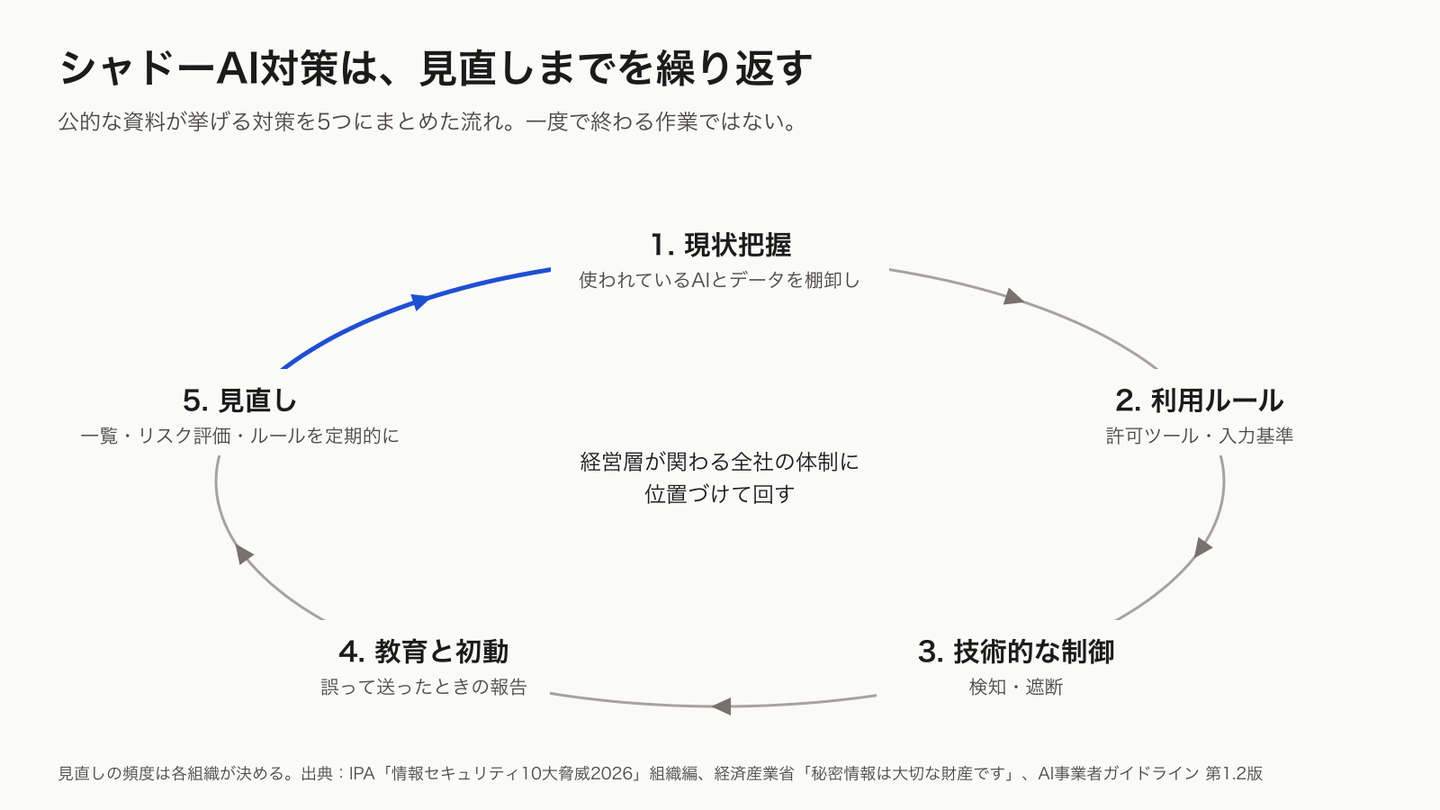
The countermeasures the public documents list can be grouped into the following five. Think of them not as a task that ends after one pass but as a flow that repeats through to review.
- Understand the current state: Take stock of the AI services in use, the departments, the accounts, and the types of data being entered. IPA lists understanding usage through communication logs, CASB, and similar means (IPA).
- Usage rules: List the AI services and accounts you permit and the information that may be entered, and decide on a contact point for applying for and reviewing new services. Defining the permitted tools and information is listed in the METI document, and restricting personal accounts and checking terms is listed by IPA (METI, IPA).
- Technical controls: Find unapproved services in communication logs, and consider warnings and blocking through DLP for the sending of confidential information. Microsoft Purview documentation shows examples of blocking pasting and uploading to AI, and prompts that contain confidential information, on managed devices and supported browsers (Microsoft Purview documentation). The scope DLP reaches varies with the device, the application, and the route.
- Training and initial response: Teach concrete examples of information that must not be entered, where to report something sent by mistake, and the steps for deleting history and contacting the provider. The reporting, deletion, and setting changes carried out in the RIZAP case are a useful reference when thinking through initial-response steps (IPA, RIZAP).
- Review: Periodically review the list of AI in use, the risk assessment, and whether the rules and controls are working. The basis is the idea of running operation and evaluation as a cycle, on p. 27 of the AI Guidelines for Business (AI Guidelines for Business). Each organization decides how often to review.
How to build internal rules and a structure for shadow AI countermeasures
The five countermeasures do not last unless responsibilities and decision criteria are set. Here we lay out how to connect the countermeasures to an AI governance structure.
First, make clear who sets company-wide policy. As the METI document points out, department-by-department measures are not enough, and senior management needs to be involved. One example of a division of roles is this: the information systems department handles understanding usage and technical controls, the risk management department handles the criteria for information that may be entered and the response to incidents, and corporate planning handles company-wide policy and coordination among departments.
Next, put the list of permitted tools and the application contact point into operation. If you decide where a department that wants to use a new AI service applies, and who reviews it against what criteria, you reduce the reasons for employees to try things out with personal accounts. Decide who handles applications and the deadline for review to suit the size of your organization.
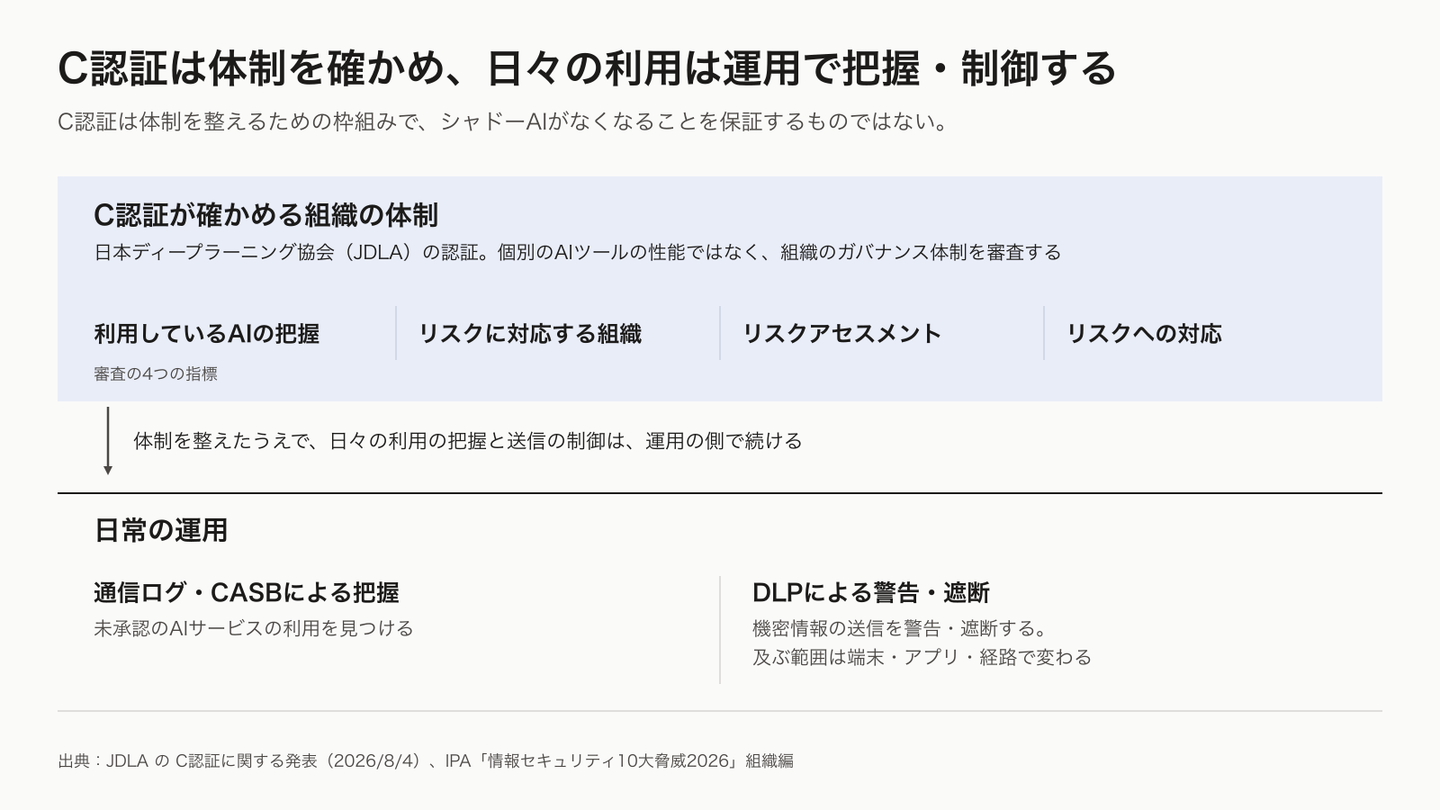
Beyond that, there is also a way to have the structure itself checked from outside. C Certification (AI Governance Core Certification) from the Japan Deep Learning Association (JDLA) examines an organization's governance structure, not the performance of individual AI tools, and uses four indicators: understanding of the AI in use, an organization for responding to risk, risk assessment, and risk response (JDLA's C Certification announcement). C Certification is a framework for putting a structure in place and does not guarantee that shadow AI will disappear. Understanding day-to-day usage and controlling what is sent need to continue on the operations side, with logs and DLP.
Summary: treat shadow AI countermeasures as part of AI governance
Shadow AI is employees using AI services that have not been permitted for work, and business data can be sent to external services even without malicious intent. The key is to carry out countermeasures as a repeating cycle of five things (understanding usage, rules on permitted tools and information, technical controls, training and initial response, and review) and to place them within a company-wide structure in which senior management is involved.
Elith is a certified consulting firm for JDLA's C Certification (JDLA's C Certification announcement). Support for obtaining C Certification is introduced at AI governance C Certification support, and the product that makes AI use visible and controls what is sent is introduced at GENFLUX Security. The issues in operations after obtaining certification are summarized in the Field Note C Certification and GENFLUX Security.
Frequently asked questions
What is shadow AI?
It is employees using, for work, AI services that their organization has not permitted or does not manage. IPA describes shadow AI as employees ending up using unapproved AI for work (IPA).
Is shadow AI prohibited by law?
None of the documents checked for this article is a law or guideline that sets a uniform prohibition under the term shadow AI. However, the AI Guidelines for Business ask users to take care not to enter personal or confidential information into AI services inappropriately, and IPA lists restricting the business use of unapproved AI services and personal accounts as an example countermeasure (AI Guidelines for Business, IPA).
Where should we start with shadow AI countermeasures?
Start by understanding which departments are using which AI services, with which accounts, and what information is being entered. Then create rules that list the permitted tools and the information that may be entered (IPA, METI).