

AI safety means more than preventing harmful outputs. On July 7, 2026, Japan's AI Safety Institute (J-AISI) published version 1.20 of its Guide to Evaluation Perspectives on AI Safety, expanding the evaluation perspectives and example evaluation items in light of the spread of AI agents (J-AISI guide page). This article summarizes the definition and evaluation perspectives in version 1.20 and explains what companies should check when they evaluate AI systems.
AI safety: definition and what the evaluation covers
J-AISI describes AI safety as a state, based on a human-centric approach, in which safety and fairness reduce societal risks, privacy protection prevents inappropriate use of personal information, security measures address vulnerabilities and attacks, and transparency supports verification and the provision of information. Societal risks include physical, psychological, and economic risks (summary, Japanese, p.3).
Of the ten common guiding principles in Japan's AI Guidelines for Business, the guide treats six as key elements of AI safety: human-centric, safety, fairness, privacy protection, ensuring security, and transparency (main text, Japanese, §2.2). The main targets of evaluation are AI systems that use LLMs as components, including AI agent systems. The guide covers effects not only on end users but also on the networks, databases, and external services the system accesses (main text, Japanese, §2.4).
How AI safety relates to AI security and AI governance
The AI Guidelines for Business, version 1.2, issued by Japan's Ministry of Internal Affairs and Communications and Ministry of Economy, Trade and Industry, list "safety" and "ensuring security" as separate items among the common guiding principles (AI Guidelines for Business, Japanese, pp.16–19). They describe AI governance as a mechanism for managing risks at a level acceptable to stakeholders while maximizing benefits, and present "agile governance," which keeps cycling through environment and risk analysis, goal setting, system design, operation, and evaluation (same, p.27).
Reading the two documents together, AI safety can be seen as the target state and the ongoing evaluation that confirms it; AI security as one of its key elements, dealing with manipulation and attacks; and AI governance as the organizational mechanism of roles, policies, risk tolerance, operation, and evaluation. This is an editorial reading that compares public documents; no unified official definition of the three terms has been published.
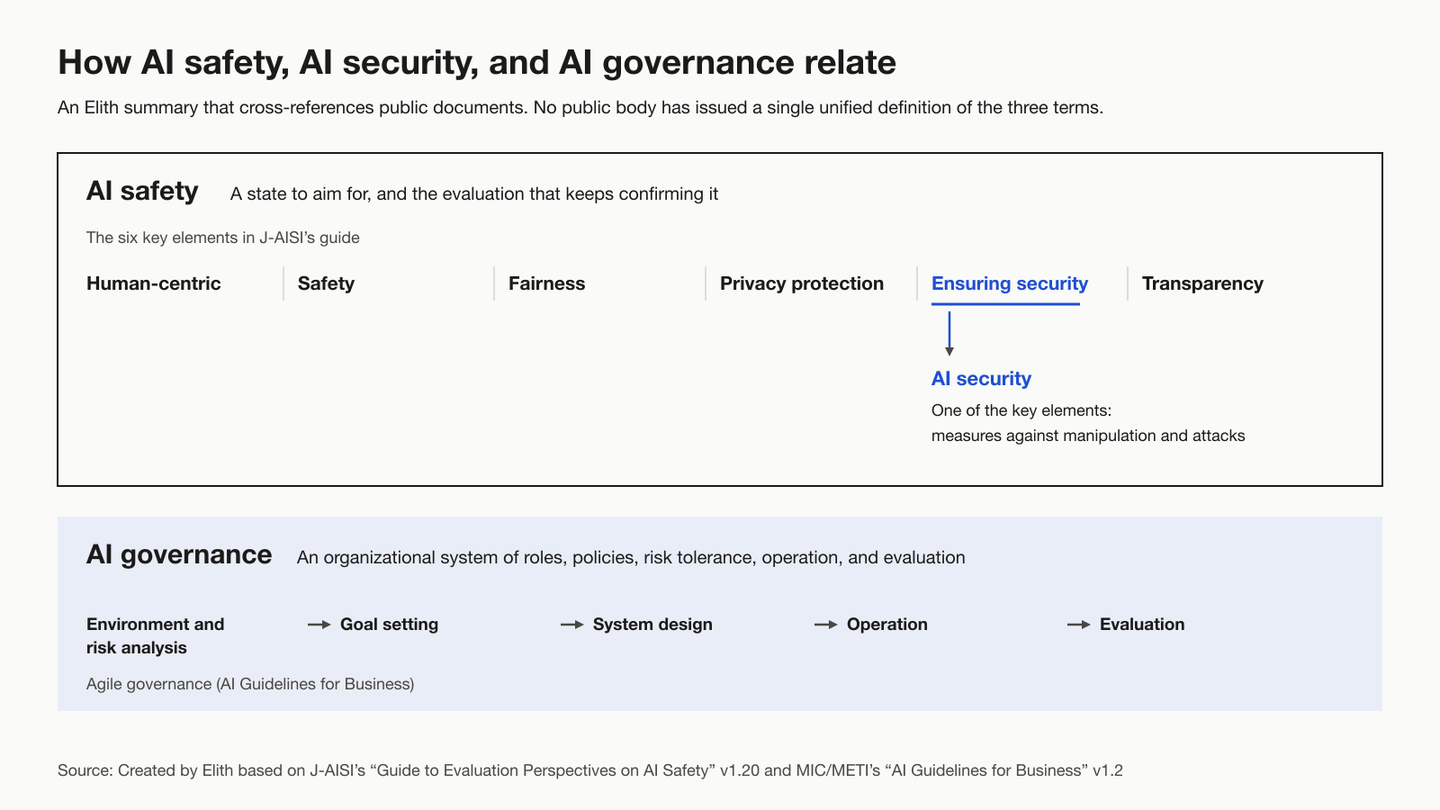
Outside Japan, the U.S. NIST AI RMF 1.0 describes "safe" and "secure and resilient" as distinct characteristics (NIST AI RMF, §3.2–3.3). In the U.K., the AI Safety Institute was renamed the AI Security Institute on February 14, 2025 (U.K. government announcement). This changed the name and focus of a U.K. institution; it does not mean the term "AI safety" has been retired.
AI safety evaluation perspectives in J-AISI version 1.20
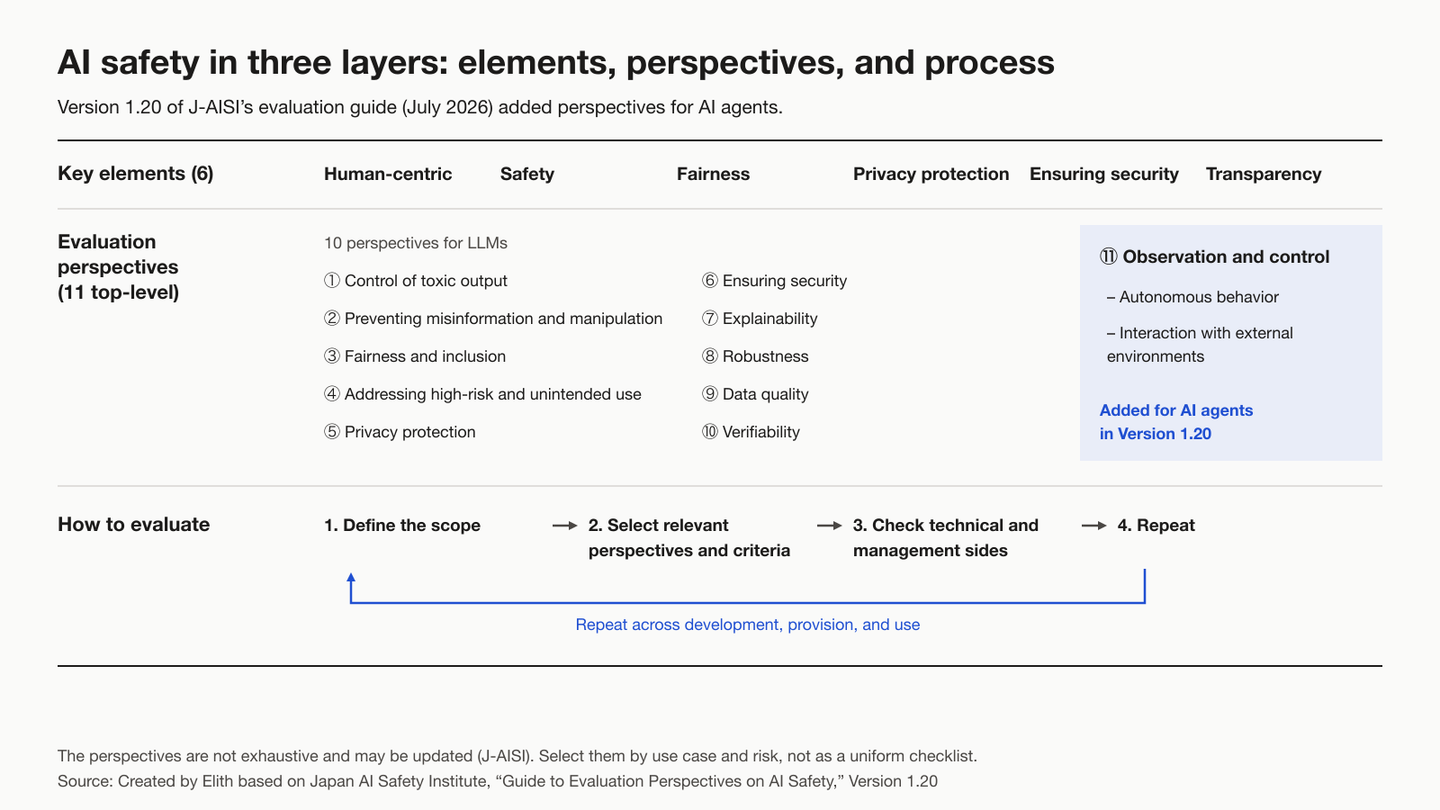
Version 1.20 adds evaluation items for AI agents to some of the previous ten perspectives for LLM systems, and creates two new agent-specific perspectives, "autonomous behavior" and "interaction with external environments" (summary, Japanese, p.8). The two are grouped under the eleventh perspective, "observation and control," so there are eleven top-level perspectives (same, pp.9–11; main text, Japanese, §3.11). Version 1.20 is published only in Japanese; the English names below are the ones used in our figure, and those for the eleventh perspective are our translations.
- Control of toxic output
- Preventing misinformation and manipulation
- Fairness and inclusion
- Addressing high-risk and unintended use
- Privacy protection
- Ensuring security
- Explainability
- Robustness
- Data quality
- Verifiability
- Observation and control (autonomous behavior / interaction with external environments)
"Autonomous behavior" looks at whether the system can observe when an agent's actions drift from the original goal or the user's intent, or when high-risk operations such as writing files or escalating privileges are carried out, and whether people can intervene or stop the agent when an anomaly is detected. "Interaction with external environments" looks at whether undesirable actions can be prevented when the system works with external tools, other agents, or physical devices, and whether people can intervene or stop it when something goes wrong (main text, Japanese, §3.11.1–3.11.2). J-AISI notes that these perspectives are not exhaustive and may be updated (summary, Japanese, p.8).
Four steps for companies evaluating AI safety
Based on the guide, we have organized the evaluation process into four steps.
- Define the scope: identify whether you are evaluating an LLM system or an AI agent system, and the effects it may have on users and the external environment, such as networks, databases, and external services (main text, Japanese, §2.4).
- Select relevant perspectives and criteria: the guide says the perspectives are not exhaustive and the evaluation items are examples, and that it is desirable to take different viewpoints depending on how autonomous an agent is and how much it connects with outside systems (same, §2.3, §3, §5.2). Rather than treating the perspectives as a uniform checklist, we recommend choosing the items to check based on your own use case and expected risks, and deciding what counts as a problem.
- Check both technical and management aspects: in addition to tool-based tests, red teaming, and tests of agent permissions, logs, and human intervention or shutdown, look at policies, rules, training, and accountability (same, §5.1–5.2).
- Repeat: evaluate repeatedly at the development, provision, and use stages. Evaluation by independent experts or third parties is also described as useful (summary, Japanese, p.12).
Attack techniques and data-leak countermeasures are covered in our guide to generative AI security, and unapproved AI use by employees in our guide to shadow AI countermeasures.
What Japanese companies should check before adopting AI agents
We recommend that companies adopting AI agents check the following.
- Is there a way for people to notice and stop an agent when it deviates from its goal?
- Have you defined which external tools and services the agent can use, and the scope of its operations?
- Does the evaluation cover rules and accountability, not just technical tests?
- Have you set times to repeat the evaluation rather than doing it once?
The J-AISI guide presents a way of thinking about evaluation; it does not define conformity certification or passing criteria. Using the guide as a starting point to build an evaluation that fits your own use case is the first step.
At Elith, we offer GENFLUX Evaluation, which evaluates chatbots, RAG systems, and AI agents for answer quality, performance, safety, resistance to attack cases, and compliance. We also offer GENFLUX RedTeam, in which, with permission, engineers try attacks on web services, APIs, and AI and review the results, so evaluation and attack-based testing can be used according to purpose.
For AI safety evaluation, see Elith's GENFLUX Evaluation.